

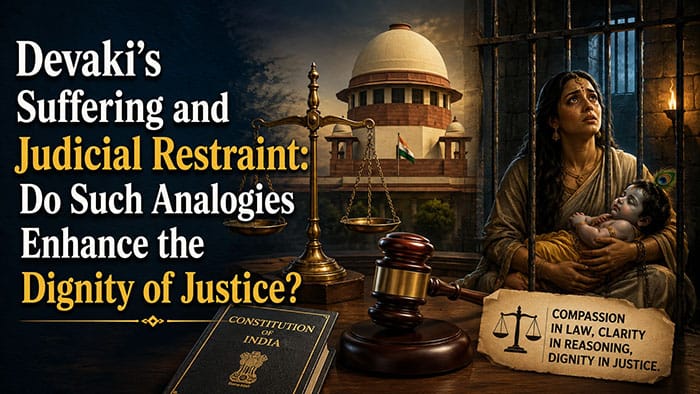

The judiciary is not merely an institution that interprets statutes; it is the constitutional conscience of a democratic republic and the custodian of public confidence in the rule of law. Every judicial pronouncement carries authority far beyond the immediate dispute before the court. Equally significant as the outcome of a judgment is the language through which that judgment is expressed. Judicial words shape legal discourse, influence public morality, and reinforce—or sometimes weaken—the people’s faith in constitutional institutions. Judicial wisdom, therefore, lies not only in arriving at a just conclusion but also in expressing that conclusion with restraint, precision, and constitutional sensitivity.
The recent bail order passed by a court in Nashik, granting bail to an accused in the TCS Nashik religious coercion and sexual harassment case, has triggered a nationwide debate for precisely this reason. While considering the accused’s pregnancy, the court referred to the birth of Lord Krishna in prison and observed that no child should have to experience such circumstances. The humanitarian concern for the welfare of an unborn child is undoubtedly a legitimate consideration in bail jurisprudence. Indian courts have consistently recognised that the interests of a child deserve protection and that incarceration of a pregnant woman requires careful judicial balancing.
However, the controversy does not arise from the grant of bail itself. It arises from the judicial analogy employed to justify the humanitarian concern.
In Indian civilisation, the birth of Lord Krishna is far more than a religious narrative. It represents the triumph of Dharma over tyranny, righteousness over oppression, and divine justice over arbitrary power. Devaki and Vasudeva were imprisoned not because they had committed any offence, but because they were victims of the irrational fear and cruelty of King Kansa. Their imprisonment symbolises the suffering of innocent people under a despotic regime. Krishna’s birth within prison walls is therefore remembered not merely as a historical or mythological event but as a profound civilisational metaphor for resistance against injustice.
This distinction is fundamental.
An individual facing criminal prosecution under the due process of law occupies a legally different position from innocent victims who were unlawfully imprisoned by a tyrant. Whether an accused is ultimately convicted or acquitted is a matter for trial, but the legal circumstances surrounding judicial custody cannot be equated with the unlawful captivity of Devaki and Vasudeva. It is therefore understandable why many observers found the comparison historically, culturally, and jurisprudentially inappropriate.
At the same time, it is equally important to distinguish between bail and acquittal. Bail does not pronounce innocence, nor does it determine guilt. It merely reflects the court’s assessment that continued incarceration pending trial is unnecessary under the facts of the case. Modern constitutional democracies recognise personal liberty as a fundamental value, and Indian bail jurisprudence has repeatedly emphasised that detention before conviction should remain an exception rather than the rule. Therefore, the legal decision to grant bail must be evaluated independently of public emotions surrounding the allegations.
Yet judicial reasoning must remain firmly anchored in constitutional principles rather than symbolic narratives.
The Constitution of India already provides sufficient jurisprudential foundations for considering the welfare of an unborn child, the dignity of motherhood, the right to personal liberty under Article 21, and the settled principles governing bail. These constitutional doctrines are fully capable of sustaining a humanitarian order without invoking religious symbolism. When judicial reasoning rests upon universally applicable constitutional principles, it reinforces institutional neutrality and commands wider public acceptance.
India is a deeply pluralistic civilisation where religious symbols carry immense historical and emotional significance. Consequently, whenever courts invoke sacred personalities or civilisational narratives, they inevitably invite interpretations extending beyond the legal issues under consideration. Public attention shifts from constitutional reasoning to the symbolic comparison itself, and the legal foundation of the judgment risks being overshadowed by cultural controversy. What should have remained a discussion on bail jurisprudence gradually transforms into a debate over faith, history, and religious sensitivity.
Judicial restraint has always been one of the defining virtues of constitutional adjudication. Courts possess moral authority not because they speak frequently on matters beyond law, but because they speak carefully, precisely, and only as much as necessary. The legitimacy of judicial institutions is strengthened when their language remains objective, constitutionally grounded, and free from avoidable analogies capable of generating public misunderstanding.
Devaki occupies a unique place in India’s civilisational memory. She symbolises innocent motherhood, undeserved suffering, unwavering faith, and the ultimate victory of righteousness over oppression. Her imprisonment cannot be understood merely as physical confinement; it represents the moral burden borne by innocent people under unjust authority. Such a symbol deserves to be preserved within its original ethical and historical context rather than employed as a general analogy in unrelated criminal proceedings.
This episode therefore raises a larger constitutional question. Should judicial orders avoid references to religious or mythological figures when constitutional reasoning alone sufficiently justifies the conclusion? A persuasive argument can be made in the affirmative. Courts neither diminish compassion nor weaken justice by relying exclusively on constitutional values. On the contrary, constitutional reasoning acquires greater universality, consistency, and legitimacy when it remains independent of religious comparisons.
Ultimately, the issue is not whether bail ought to have been granted. The real question concerns the language through which judicial compassion is expressed. Justice is measured not only by the correctness of its conclusions but also by the dignity of its reasoning. Constitutional courts command public confidence because they embody neutrality, restraint, and fidelity to law. Their language should therefore reflect the same constitutional discipline that their judgments seek to uphold.
In a nation where faith and constitutionalism coexist, judicial language must serve as a bridge between legal certainty and cultural sensitivity—not as a source of avoidable controversy. The dignity of justice is enhanced not by rhetorical analogies, however well-intentioned, but by careful reasoning rooted firmly in constitutional principles. That is the true hallmark of judicial statesmanship and the enduring strength of India’s constitutional democracy.