
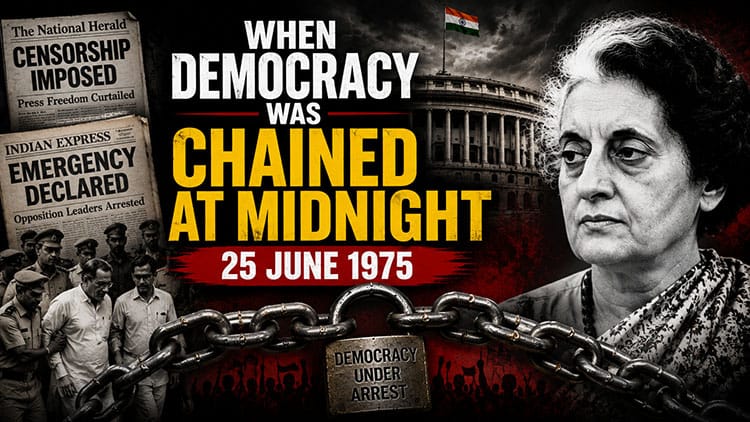

India can never forget the day the Emergency was imposed, effectively strangling democracy. It is a stain on the Congress party that cannot be washed away for generations. Indian democracy can never forget the date of June 25, 1975. That night, while the nation slept, the Congress government—seated at the pinnacle of power—sealed a decision that curtailed civil liberties guaranteed by the Constitution, criminalized dissent, and subjected democratic institutions to unprecedented pressure..
The Emergency was not merely a political event. It was a test of democratic institutions, constitutional safeguards, and the resilience of ordinary citizens. It demonstrated how concentrated political power can threaten civil liberties and how democratic systems can be vulnerable when authority becomes centralized in the hands of a few.
The immediate backdrop to the Emergency lay in a dramatic judicial verdict. On 12 June 1975, Justice Jagmohanlal Sinha of the Allahabad High Court delivered a historic judgment invalidating Prime Minister Indira Gandhi’s election to the Lok Sabha. The case had been filed by Raj Narain, who alleged electoral malpractice. The court found that government machinery and official resources had been improperly used during the election campaign.
The verdict shook the foundations of Indira Gandhi’s political authority. Her legitimacy as Prime Minister was suddenly under question. Across the country, opposition parties intensified their protests. At the forefront stood Jayaprakash Narayan, popularly known as JP, who called upon the people to launch a movement for democratic renewal. Massive rallies were organized, including a historic gathering at Delhi’s Ramlila Maidan where JP openly demanded the Prime Minister’s resignation.
Political unrest was already visible in several parts of the country. The Navnirman Movement in Gujarat had demonstrated widespread public dissatisfaction with corruption and governance. Faced with mounting opposition and political uncertainty, Indira Gandhi and her advisers turned to a constitutional provision that would have far-reaching consequences.
On the night of 25 June 1975, President Fakhruddin Ali Ahmed signed the proclamation of Emergency under Article 352 of the Constitution, citing “internal disturbance” as the justification. The declaration was constitutionally permissible, but critics have long argued that its use violated the spirit of democratic governance.
The consequences were immediate. Opposition leaders were arrested in overnight raids. Jayaprakash Narayan, Morarji Desai, Atal Bihari Vajpayee, Lal Krishna Advani, Chandrashekhar, and many others were taken into custody. Newspapers faced unprecedented restrictions, and in some cases, electricity supplies to newspaper offices were reportedly cut to prevent publication of critical reports.
By the morning of 26 June, India had entered a new political reality.
Although the Constitution provides for emergency powers during extraordinary situations such as war or armed rebellion, critics argue that the circumstances of 1975 did not justify such a drastic measure. Many scholars have described the Emergency as an attempt to preserve political power rather than protect national security.
Journalist Kuldip Nayar, in his book Emergency Retold, argued that Article 352 was used in a manner never intended by the framers of the Constitution. What had been envisioned as a safeguard for the nation became, in the eyes of many observers, a mechanism for suppressing dissent.
The constitutional structure itself underwent significant changes during this period. The government introduced the 42nd Constitutional Amendment, one of the most controversial amendments in Indian history. It expanded the powers of the central government and altered the balance between institutions.
Fundamental rights were suspended. Courts found themselves constrained in protecting citizens from arbitrary detention. One of the most controversial legal episodes occurred in the famous ADM Jabalpur v. Shivkant Shukla case. The Supreme Court ruled by majority that during the Emergency, citizens could not seek judicial remedy against unlawful detention.
The judgment has since been widely criticized by constitutional scholars and later members of the judiciary. Many regard it as one of the most troubling moments in the history of the Indian legal system.
The press became another major target. Democracies depend upon a free flow of information, yet censorship during the Emergency was extensive. Newspapers were required to submit material for government approval before publication. Publications that resisted official directives faced severe pressure, including withdrawal of government advertising and other forms of administrative action.
Prominent journalist and publisher Ramnath Goenka, founder of The Indian Express, became a symbol of resistance. His newspaper attempted to challenge official censorship, sometimes leaving editorial spaces blank to signal restrictions on free expression. Other publications also found creative ways to protest.
Nevertheless, many media organizations chose compliance over confrontation. Years later, L.K. Advani famously remarked that when the media was merely asked to bend, it chose instead to crawl.
State-controlled broadcasting institutions such as All India Radio and Doordarshan functioned largely as instruments of government messaging. Foreign correspondents faced increasing restrictions, and some were expelled from the country. As a result, much of the world remained unaware of the full extent of developments unfolding within India.
The Emergency demonstrated how quickly democratic freedoms can be curtailed when institutional checks weaken and power becomes concentrated. Yet the story of this period was not solely one of repression. It was also a story of resistance, resilience, and the enduring desire for freedom.