

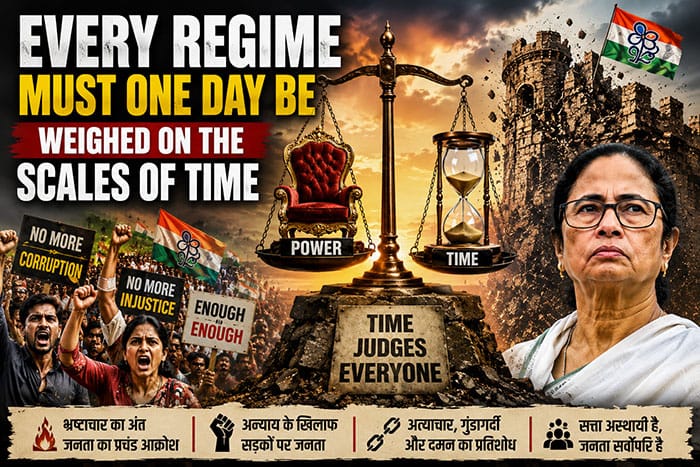

Every government and every political power must one day be weighed on the scales of time. This is precisely what appears to be happening in West Bengal today. When time began its assessment, even what seemed to be an impregnable political fortress started showing signs of collapse. As long as the pressure of power remains, ordinary people often silently endure injustice because those in authority possess countless means to intimidate and suppress dissent. However, when oppression and harassment cross the limits of human endurance, years of accumulated anger erupt like a volcano. The current political and social atmosphere in West Bengal is being portrayed by many observers as an example of such accumulated public resentment.
Public anger has reportedly reached a level where several leaders of the ruling establishment have faced intense opposition in public spaces. Slogans accusing political figures of corruption are being raised, and resentment against certain leaders appears to have grown significantly. Many local leaders who once exercised considerable influence are now reportedly facing strong public hostility. This situation did not emerge overnight; rather, it is being attributed to years of grievances, allegations of corruption, and perceptions of political intimidation.
Many individuals who benefited from the political system during Mamata Banerjee’s tenure are now reportedly seeking political alternatives. At the same time, sections of the public who believe they suffered from corruption and coercion are expressing resistance to the entry of such leaders into other political parties. According to this view, people who experienced political pressure, extortion, or administrative injustice have carried a deep sense of frustration for years. When fear gradually disappears, suppressed anger often finds expression.
During the years of political conflict in Bengal, several incidents of violence and arson were reported. Many families allegedly witnessed their homes and livelihoods being destroyed. The events in Sandeshkhali, where serious allegations of abuse and exploitation surfaced, generated widespread national debate and outrage. These incidents left a deep impact on public consciousness and raised questions about governance and accountability.
Similarly, the tragic rape and murder of a woman doctor at Kolkata’s RG Kar Medical College and Hospital intensified public anger. Hospitals are regarded as places dedicated to saving lives, and such a horrific crime shocked the nation. Allegations regarding administrative lapses and attempts to downplay the seriousness of the matter further weakened public confidence in institutions.
When those entrusted with responsibility are perceived to have failed in their duty, public patience eventually reaches a breaking point. The pain caused by crimes against women has intensified the anger already present in society. According to political discussions and speculation, fear of public backlash has contributed to growing divisions within the ruling party, with reports and rumors of internal dissent becoming increasingly common.
Many political leaders are believed to understand that public sentiment is changing rapidly. Consequently, some may be attempting to distance themselves from a system that is increasingly being criticized. Such moves are often interpreted as efforts at political survival during a period of uncertainty.
A widely discussed video showed Mamata Banerjee visiting a Kali temple, where some observers claimed that devotees paid little attention to her presence. Whether symbolic or incidental, the episode has been interpreted by critics as a reminder that public admiration can be temporary. A leader who once commanded immense popularity can eventually find public enthusiasm fading. In politics, respect and influence ultimately depend upon the people’s confidence.
The developments in Bengal serve as a reminder that political power and position are never permanent. Those who ignore public concerns, tolerate corruption, or allow political intimidation to flourish may eventually face public rejection. While acts such as throwing stones, eggs, or shoes cannot be justified under the law, it is also important to understand the social and psychological conditions that can drive ordinary citizens toward extreme expressions of anger.
Ultimately, the grand throne of political power in a democracy rests upon the shoulders of the people. When those shoulders withdraw their support, even the mightiest structures of authority can crumble. The events unfolding in Bengal, regardless of political interpretation, offer an important lesson to all leaders: power is temporary, but public judgment is enduring.