

The first half-yearly meeting of the Akhil Bharatiya Karyakarini and Pratinidhi Mandal of Rashtra Sevika Samiti, held at Samalkha, Haryana, from 24–26 July 2026, concluded with a significant discussion on one of the most sensitive issues confronting contemporary India—demographic change and population imbalance. While reviewing the organisation’s expanding work across the country, the meeting also adopted a resolution expressing concern over demographic trends and urging the Union and State governments to implement a uniform national population policy applicable to all communities and to enact a Uniform Civil Code.
The meeting marked an important milestone as the organisation enters its 90th year. Representatives from forty provinces reviewed the steady growth of organisational activities, which now extend to 852 districts through 4,886 daily branches and 1,173 regular gatherings. Alongside organisational expansion, deliberations focused on contemporary social challenges, particularly those affecting women, youth, and the long-term future of Indian society.
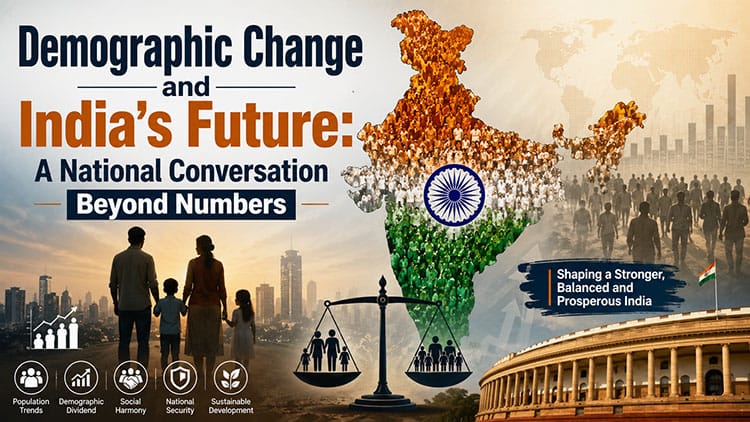
Among all the issues discussed, demographic change emerged as the central theme. The resolution described population imbalance as a matter of national concern and argued that demographic trends influence not merely the size of the population but also social stability, cultural continuity, national security, and long-term development. It called for greater public awareness and policy attention to these issues.
The debate over demography is neither new nor confined to India.
Across the world, governments are grappling with complex demographic transitions. Several developed nations face declining birth rates and rapidly ageing populations, while others struggle with migration pressures, uneven regional population growth, and changing workforce structures. India, despite being the world’s most populous nation, presents a unique picture. Fertility rates differ significantly across states, internal migration is reshaping urban centres, border regions face security and migration-related concerns, and the country must prepare for an ageing population in the decades ahead.
These developments raise important public policy questions. How can India preserve its demographic dividend while ensuring equitable development? How should policymakers balance individual rights, women’s empowerment, public health, economic planning, and national interests? What institutional mechanisms are required to address migration, regional disparities, and long-term population sustainability?
The resolution adopted by Rashtra Sevika Samiti reflects one perspective within this broader national debate. It links demographic imbalance with issues such as illegal immigration, religious conversion, family structure, and social responsibility, and urges legislative and administrative action in these areas. These are matters of public discussion and differing viewpoints exist regarding both the causes and the appropriate policy responses. In a democratic society, such questions require careful examination through constitutional principles, reliable demographic evidence, and informed public debate.
Demography is ultimately more than a statistical exercise. It shapes economic productivity, educational planning, healthcare systems, labour markets, housing, social security, and national preparedness. India’s current demographic advantage—its relatively young population—offers a historic opportunity. However, if employment generation, skill development, women’s participation in the workforce, healthcare, and family welfare do not advance simultaneously, this advantage may gradually diminish.
The concluding address of the organisation’s chief guide drew inspiration from the historic land of Kurukshetra, calling upon workers to strengthen their character and expand their service with discipline and dedication. The broader message extends beyond any single organisation: nation-building requires citizens who combine commitment with responsibility and long-term vision.
The demographic question before India should therefore not be viewed merely through the lens of numbers or electoral arithmetic. It is fundamentally about the future composition of society, the sustainability of development, the preservation of social harmony, and the capacity of institutions to respond to changing realities. Addressing these challenges demands evidence-based policymaking, constitutional fidelity, social responsibility, and constructive dialogue among all stakeholders.
India’s demographic future will not be determined by population figures alone. It will be shaped by the wisdom with which the nation transforms demographic change into demographic strength.
✍️ Kailash Chandra
Kailashchander74@gmail