
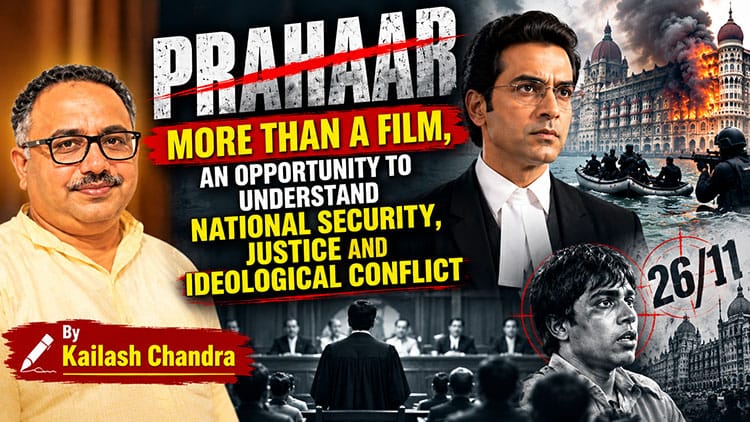

Every Indian should watch Prahaar. Watching the film alone, however, is not enough. It is equally important to understand its historical context, the legal battle it portrays, and the questions it raises about national security.
Ajmal Kasab is not merely the name of a terrorist. He represents the horrific tragedy of 26/11, in which innocent civilians and security personnel lost their lives. The legal battle against him demonstrates that national security is not confined to the country’s borders. It is also connected with the strength of our institutions, the rule of law, and the moral resilience of society.
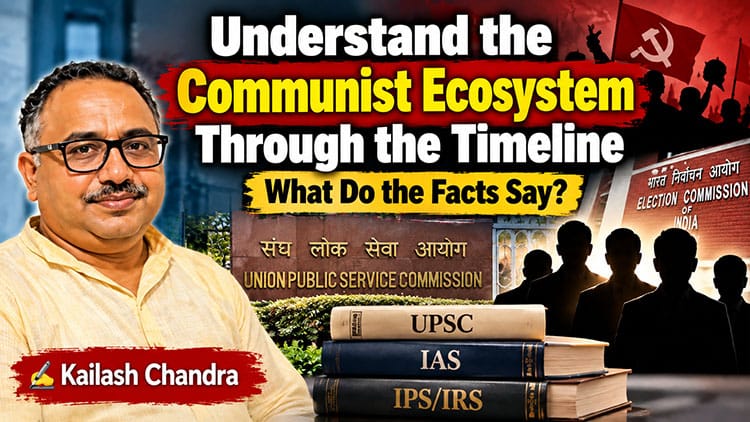
In this context, the political and ideological support expressed for individuals associated with different cases, such as Afzal Guru, Burhan Wani, Umar Khalid, and Sharjeel Imam, also deserves an evidence-based examination. Their roles, the cases against them, and the judicial findings in their respective matters are not identical. Therefore, before labelling anyone a supporter of terrorism or a criminal, it is essential to examine the evidence, legal status, and actual statements involved.
Sympathy for Terrorism or Ideological Justification of Violence Is Unacceptable
Demanding due legal process for a terrorist and supporting that person’s crime are two different things. Similarly, opposing the death penalty, expressing sympathy for a convicted person, and justifying terrorist violence are not the same.
However, when someone glorifies a terrorist attack, supports violence, or calls for the violent overthrow of the constitutional order, legal action should follow in accordance with the law.
While discussing Afzal Guru, Burhan Wani, Kasab, and the public debates surrounding them, these distinctions must be understood. Violence cannot be accepted under the pretext of ideological freedom. At the same time, treating dissent, peaceful protest, or criticism of the government as criminal without evidence would also be contrary to democratic values.
‘Regime Change’: The Difference Between a Change of Government and Destabilising the System
In a democracy, the people have the right to change their government. Elections, public opinion, peaceful movements, and constitutional political activities are natural parts of the democratic process. Therefore, the term ‘regime change’ cannot, by itself, be used to brand someone as anti-national.
However, if a plan is devised in the name of regime change to incite violence, weaken constitutional institutions through foreign interference, legitimise terrorist activities, or overthrow the democratic system by force, it deserves an impartial investigation. If evidence establishes wrongdoing, action should be taken in accordance with the law.
By the same standard, the activities, statements, and political campaigns of left-wing and Marxist organisations, including AISA, can also be examined critically. An organisation’s ideology is not, in itself, proof of a crime. Nevertheless, no organisation should be exempt from accountability for violence or unlawful activities.
Intellectual Naxalism: Identifying Conduct Through Evidence
Here, the term ‘intellectual Naxalism’ refers to giving ideological legitimacy to violence, glorifying terrorist activities, seeking to destroy democratic institutions by force, and assisting the activities of banned violent organisations. Such conduct must be clearly opposed.
Identifying genuine threats to national security requires facts and evidence, not merely slogans. Any action against an individual or organisation must be based on specific acts, available evidence, and applicable law. Strict and impartial enforcement of the law is a testament to the institutional strength of the nation.
The Message of ‘Prahaar’
One important reason to watch Prahaar is to understand that the fight against terrorism requires courage alongside wisdom, patriotism alongside constitutional commitment, and determination alongside justice.
Rajkummar Rao’s portrayal of Ujjwal Nikam draws viewers’ attention to the legal battle in which a person accused of terrorism was convicted by a court on the basis of evidence. The message of this process is clear: the strength of justice lies not in revenge, but in evidence, the rule of law, and institutional resolve.
It is important to remember Kasab’s crimes. Even more important, however, is to strengthen the system that holds offenders accountable before the law.
Thus, Prahaar is not merely an invitation to watch a film. It is also an opportunity for serious discussion on national security, ideological accountability, and democratic values.
Zero tolerance for terrorism, clear opposition to the ideological justification of violence, protection of the democratic system, and strict and impartial enforcement of the law are essential to safeguarding the national interest.
Rajkummar Rao’s Powerful Transformation and a Story Based on Real Events
Rajkummar Rao’s striking transformation, Avinash Arun’s direction, and a story rooted in an event that shook the entire nation give Prahaar the potential to become a compelling cinematic experience.
Cinema is not merely a source of entertainment. Sometimes it makes us laugh, sometimes it moves us to tears, sometimes it fills us with excitement, and sometimes it brings us face to face with pages of history that we do not wish to forget. Some films tell stories on screen, while others portray courage, struggle, duty, and human determination through their characters, leaving a lasting impression on audiences.
Rajkummar Rao’s Prahaar: The Untold Story of Ujjwal Nikam raises expectations of becoming an important film in the latter category.
Rajkummar Rao: The Challenge of Becoming the Character
Rajkummar Rao is among those actors who seek to bring their characters to life not merely through dialogue, but also through facial expressions, body language, voice, and subtle aspects of personality. Playing the role of Ujjwal Nikam, a well-known public prosecutor, in Prahaar presents him with a fresh and challenging test.
Portraying a lawyer entrusted with one of the country’s most high-profile terrorism cases demands much more than conventional acting. Presenting sharp courtroom arguments, confidence under pressure, attention to evidence, and unwavering commitment to justice on screen is a considerable challenge for any actor.
Given Rajkummar Rao’s acting abilities, the audience’s curiosity is understandable. The depth, seriousness, and credibility he brings to the character will be among the film’s most intriguing aspects.
Avinash Arun’s Direction: The Challenge of Turning a Real Event into a Cinematic Experience
Making a film based on real events is not easy. Audiences expect suspense, emotional engagement with the characters, and credibility in the portrayal of events. A director must strike a balance among all three.
Avinash Arun faces the same challenge. His direction will be tested by how effectively he transforms the horror of the 26/11 Mumbai terrorist attacks, the subsequent investigation, the courtroom battle, and the struggles of the people involved into a compelling cinematic experience.
In such a film, a courtroom is more than just a location. It becomes a stage where arguments, evidence, patience, and justice are put to the test. If these elements are presented with sensitivity and impact, the film can do more than make viewers witnesses to events. It can also help them connect with the struggle behind them.
Dinesh Vijan and His Team: An Important Initiative in Choosing the Subject
Producer Dinesh Vijan and his team have chosen a subject centred on Ujjwal Nikam’s life and the 26/11 trial. The story encompasses several dimensions of India’s recent history, the justice system, and the professional responsibilities undertaken under extraordinary circumstances.
Audiences today have numerous entertainment options. Bringing a real legal battle to the big screen therefore demands particular responsibility in research, screenplay, acting, and presentation. A producer’s role is not limited to making a film. Reaching the right audience and generating interest in the subject are equally important.
From this perspective, the choice of subject for Prahaar is noteworthy. Such films can introduce audiences to people who have played important roles in significant national events but whose stories have reached the wider public only to a limited extent.
Wamiqa Gabbi, Lalit Prabhakar, Jaideep Ahlawat and Sikandar Kher: The Importance of the Cast
A film’s success does not depend solely on its lead actor. Supporting characters, their relationships, the credibility of the dialogue, and their contribution to the narrative also help make a film effective.
The presence of actors such as Wamiqa Gabbi, Lalit Prabhakar, Jaideep Ahlawat, and Sikandar Kher adds to the anticipation surrounding the film. In a story based on real events, every character has a role to play. Through their performances, actors have an opportunity to convey the gravity of events, the tension of the circumstances, and the human dimensions of the story.
Particularly in a subject involving the courtroom, investigation, and multiple aspects of a national tragedy, balanced performances by the entire cast can play an important role in making the narrative credible.
The Memory of 26/11 and the Fight for Justice
The Mumbai terrorist attacks of 26 November 2008 remain among the events in India’s history that evoke pain and anger even today. A total of 166 people lost their lives in the attacks. Ajmal Kasab was captured alive, and the legal proceedings against him drew nationwide attention.
Ujjwal Nikam led the prosecution as the special public prosecutor in the case. Through his character, the film has an opportunity to portray a professional whose tools were not weapons, but evidence, arguments, and the law.
This is what makes the story distinctive. The fight against terrorism does not end with operations by security forces. Establishing the truth, proving the crime in court, and ensuring justice through lawful procedures are equally essential.
Prahaar attempts to bring this broader struggle before audiences. Its appeal lies not only in the life of a well-known individual, but also in the demanding responsibility that requires patience, preparation, courage, and professional competence.
Why Should You Watch ‘Prahaar’?
For film enthusiasts, Prahaar offers several points of interest: Rajkummar Rao in a new avatar, a story based on real events, the conflict of arguments and strategy inside a courtroom, and a cinematic portrayal of a subject connected with the nation’s collective memory.
Viewers who enjoy courtroom dramas may find the story particularly interesting. Those who prefer films based on real events may appreciate the combination of history and cinema. For audiences who value the finer aspects of acting, Rajkummar Rao’s performance as Ujjwal Nikam will be another reason for anticipation.
The film’s actual achievement will depend on how effectively its screenplay, direction, acting, and factual presentation engage audiences. Nevertheless, the subject it has chosen certainly deserves serious and extensive discussion.
Conclusion: Such Stories Give Cinema a Distinct Identity
Hindi cinema becomes richer when it gives space not only to romance, comedy, suspense, and family entertainment, but also to struggles drawn from real life. Such stories do more than entertain audiences for a few hours. They also offer an opportunity to reflect on people’s lives, decisions, and responsibilities.
When an actor of Rajkummar Rao’s calibre, a director like Avinash Arun, and a producer such as Dinesh Vijan attempt to bring a real and significant subject to the screen, audience expectations naturally rise.
At the heart of Prahaar lies a struggle in which the stakes go beyond the outcome of a single trial. The central question is the establishment of justice itself. This gives the film the potential to distinguish itself from conventional entertainment.
Best wishes to the entire team for taking the initiative to bring this subject to the big screen. It is hoped that Prahaar will offer audiences a compelling cinematic experience and further encourage interest in Hindi films based on real events, challenging characters, and serious subjects.
A good film is one that continues to occupy the viewer’s mind even after the curtains fall. The same is expected of Prahaar.
By Kailash Chandra