
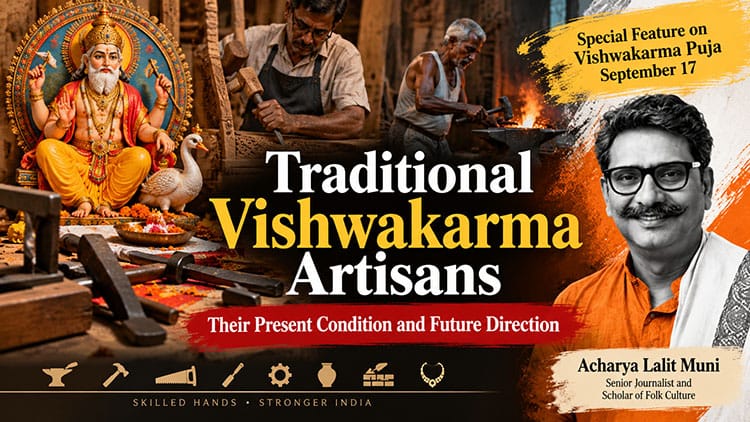
Special Feature on Vishwakarma Puja, September 17
Today, September 17, is observed as Vishwakarma Puja. On this day, one may see a vermilion mark placed on the machines in a factory, while in a carpenter’s workshop, saws and hand planes are cleaned and arranged for worship. Flowers are offered on the tools kept beside a blacksmith’s furnace, and small artisans too bow before the instruments through which they earn their livelihood. The scene may appear modest, but behind it stands a tradition that goes back centuries. The question is: what is the present condition of the hands that once shaped temple spires, palace doorways, agricultural tools and countless objects of everyday use, and what direction does their future hold?
The term Vishwakarma community refers to traditional artisan families who connect themselves, according to their community traditions, with the five sons of Vishwakarma: Manu, Maya, Tvashta, Shilpi and Devajna. In popular and Puranic traditions, Manu is associated with blacksmithing, Maya with carpentry or the work of the sutars, Tvashta with bronze and metalworking, Shilpi with masonry and stone craftsmanship, and Devajna with goldsmithing. These diverse craft traditions together came to be identified with the broader Vishwakarma social identity.
In medieval India, these communities were associated with temple construction, sculpture, metalwork, carpentry and building construction. A farmer needed a plough and there was a blacksmith; a house had to be built and there were carpenters and masons; metal utensils were needed and there was the traditional metalworker; jewellery required the skills of the goldsmith. In this manner, artisans formed an important part of the system that met the everyday needs of rural society.
मनुर्मयस्तथा त्वष्टा शिल्पी देवज्ञ एव च ।
विश्वकर्मासुता ह्येते पंच सृष्टिप्रवर्तकाः ॥
According to this tradition, these five are regarded as the sons of Vishwakarma and as pioneers of the creative and constructive arts. The worship of tools during Vishwakarma Puja carries forward the idea that both the hand that creates and the instrument it uses deserve respect. On September 17, machines and tools are worshipped in industrial areas as well as in small workshops in villages with the same sentiment.
However, there is a visible gap between the traditional prestige associated with craftsmanship and the present socio-economic condition of many artisan communities. Several traditional artisan castes associated with these occupations are included in the Other Backward Classes lists in different states. The representation and population of smaller and fragmented sub-groups have also remained subjects of discussion for a long time. Caste-based data can be important for policymaking because a clearer understanding of population size and economic conditions can help in better targeting of welfare and development programmes.
A contradiction is also visible in language and literature. Vishwakarma is revered as the divine architect and is associated with architecture and craftsmanship, yet many of the artisan castes connected with this tradition were historically placed low in the social hierarchy. Today, organisations representing these communities speak, on the one hand, of the dignity of their traditional skills and, on the other, demand greater opportunities in education, employment, financial assistance and representation. These demands are not only about social identity; they are also about securing a place in an economy that is changing rapidly.
Industrialisation in the twentieth century created a new challenge for this tradition. Machines made production faster and cheaper, but the traditional markets on which artisan families depended gradually contracted. The village blacksmith, who once made ploughs, sickles and agricultural tools, had to compete with factory-produced goods. Carpenters faced the growing market for ready-made furniture and plywood. In goldsmithing too, machines, laser technology and large-scale production created new forms of competition. A section of the younger generation began leaving hereditary occupations and moving towards salaried employment, daily-wage labour and other forms of informal work in cities.
The problem, however, is not simply the arrival of machines. The deeper question is that of the market and the value of labour. An artisan creates a product, but between the artisan and the consumer there are often several layers of traders and intermediaries. As a result, artisans frequently fail to receive a fair return for their labour. After the COVID-19 pandemic, rising raw-material costs, market uncertainty and competition from inexpensive machine-made and imported goods added to the difficulties. Therefore, protecting traditional crafts cannot mean merely providing artisans with tools. It also requires the creation of sustainable markets for their products.
It is in this context that the PM Vishwakarma scheme, launched in September 2023, has emerged as an important initiative. The scheme covers 18 traditional trades. Eligible artisans are provided support through skill training, toolkit incentives, incentives for digital transactions and collateral-free loans. The objective is to connect traditional skills with formal recognition and financial support.
Yet the real meaning of the success of any scheme lies in whether it reaches its intended beneficiaries. Registration procedures, documentation, banking requirements and limited access to digital information can become barriers for many artisans. Even after receiving a toolkit, increased production does not necessarily mean increased income if there is no market for the products. Along with training and credit, therefore, artisans also need knowledge of design, packaging, quality standards, branding and digital marketing.
The way forward for traditional crafts is not to oppose machines, but to create a productive coexistence between machines and skilled hands. Systems such as geographical indications, or GI tags, can give distinctive craft products a recognised identity. Exhibitions and digital marketplaces can connect artisans directly with consumers. If an artisan can display products through a mobile phone and reach customers in cities or even abroad, dependence on intermediaries can be reduced.
Artisans do not have to merely repeat old methods. Their traditional skills can be combined with new designs and new markets. The distinctive character of handmade craftsmanship can be identified and presented as a market advantage. Woodwork, metalwork, pottery, stone craftsmanship, jewellery and traditional tools can be adapted into contemporary products and everyday objects, creating new demand. India’s handicraft exports have been worth thousands of crores of rupees, indicating that a market exists. The larger challenge is to ensure that artisans can actually reach that market.
सहजं कर्म कौन्तेय सदोषमपि न त्यजेत्।
सर्वारम्भा हि दोषेण धूमेनाग्निरिवावृताः॥
This verse from the Bhagavad Gita speaks of not abandoning one’s natural or inherited work even when it becomes difficult. In the context of the Vishwakarma community, the verse provides a cultural basis for understanding the situation of an artisan who does not wish to completely abandon the hereditary skill passed down through generations despite changing circumstances. But tradition cannot survive on sentiment alone. It needs a sound economic foundation along with respect.
On Vishwakarma Puja, placing flowers on tools is easy. The harder task is to ensure throughout the year that the hands which use those tools receive dignity, work and a fair income. If policy, markets, technology and the skills of the younger generation come together, traditional artisans can strengthen their identity once again.
A society that spent centuries shaping temple spires and household doorways cannot be reduced to a memory of the past. Its artisans possess experience, generations of accumulated knowledge and the ability to learn and adapt to changing needs. What they need is not merely respect for their skills, but opportunities to take those skills forward.
Perhaps this is the deeper message of Vishwakarma Puja: along with worshipping machines, we must also care for the hands that operate them and for the creative traditions through which those hands continue to shape our world.
Acharya Lalit Muni
Senior journalist and scholar of folk culture