
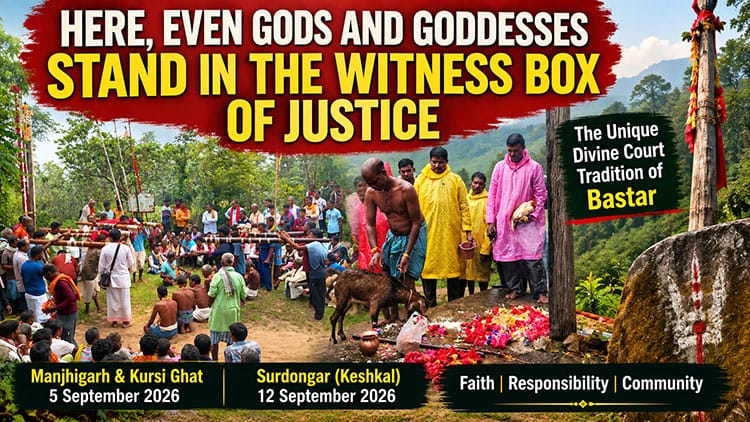

During the Bhādo Jatra in Bastar, one can see hills stretching into the distance, roads lined with sal trees, and groups of people moving towards a shrine located away from the settlements. They carry offerings, along with the sacred symbols of village deities. Sirhas, Gaytas, Manjhis and other villagers accompany them. This is not an ordinary religious procession. Here, worship is accompanied by a tradition in which the deities themselves are called upon to account for their responsibilities. According to local belief, if a deity has failed to protect its territory or safeguard the village from calamities, the deity too may have to answer for that failure.
This unique folk tradition is popularly described as the “court of gods and goddesses.” It is not a court of law in the modern sense, but a centuries-old religious and community-based system. The most well-known centre of this tradition is the Jatra of Maa Bhangaram Devi. The Dev Darbars associated with Garh Mavli of Manjhigarh and Maa Bhangaram of Karipani Kursi Ghat are also important centres of this tradition. This year, the tradition will be observed at Manjhigarh and Kursi Ghat on Saturday, 5 September 2026, while the event at the Bhangaram Devi shrine in Surdongar, Keshkal, will be held on Saturday, 12 September 2026.
One of the distinctive features of this tradition is that the proceedings do not take place at a single location. There are three major centres.
The first is the shrine of Maa Bhangaram Devi in the forested and hilly Surdongar area of Keshkal. After the Saturday service and worship, the traditional court is held the following morning.
The second centre is the Darbar of Garh Mavli Devi at Manjhigarh in the Bade Rajpur area. Here, the proceedings related to such matters are locally referred to as “Jaanch,” or investigation.
The third centre is the shrine of Maa Bhangaram Devi located between Karipani and Kursi Ghat in the Nagri area of Dhamtari district.
The geographical settings of these three places are different, but the underlying folk belief is similar: deities are not merely objects of worship. They are regarded as powers entrusted with responsibilities.
This tradition is not confined to a single village. At the Keshkal Jatra, deities from villages belonging to 11 parganas are believed to participate. At the Garh Mavli Darbar in Manjhigarh, deities from 72 villages associated with the Garh region arrive. At Karipani Kursi Ghat, deities connected with 16 parganas of the Nagri region, seven palis of Odisha, and a 20-kos area of Bastar participate. Terms such as pargana, pali and kos refer not merely to geographical distance but also preserve memories of older forms of rural community organisation.
In an ordinary court of law, a human being may stand accused, and a decision is reached on the basis of evidence and legal reasoning. Bastar’s traditional divine court is fundamentally different as a cultural institution, yet the idea of accountability remains central to it. According to local belief, if a village repeatedly experiences misfortune, illness or other forms of crisis, the concerned deity may be subjected to an inquiry.
It would be simplistic to dismiss this tradition merely as superstition. Within it lies an ethical idea that connects power with responsibility. A deity who is believed to possess protective powers is also expected to fulfil the responsibilities associated with that power.
According to local priests, a deity considered responsible for a failure may, in some traditions, be kept away from worship for a certain period or even symbolically confined for a prescribed duration. The idea of confinement should not be interpreted as imprisonment in the modern legal sense. It belongs to the cultural vocabulary of local religious belief.
The Sirha plays the role of an intermediary between the world of folk belief and the divine power, while traditional community representatives such as the Gayta, Manjhi, Mukhiya and Patel represent the social structure of the community.
When deities from different villages arrive at one place with their sacred symbols, the entire setting transforms into a vast community gathering. Calling it merely a “court” would therefore limit its true character. It is simultaneously a divine assembly, religious Jatra, community gathering and traditional form of folk justice.
Villagers perform seva and puja with rice, oil, turmeric, flowers, incense and other offerings. There is also a tradition of bringing before the goddess what is believed to be a harmful or malevolent force that has entered the village, sometimes described locally as being brought in the form of a “Ravana.”
Traditional restrictions on the entry of women during the main proceedings of these Jatras have also been mentioned in accounts of the tradition. According to journalist and social worker Shri Krishna Dutt Upadhyay, this practice is not rooted in any intention to insult local women. Rather, it is associated with the belief that women should be kept away from the harmful or malevolent force brought from the village during the Jatra. At other times, women normally visit the shrine and offer prayers.
Another interesting figure in the folk beliefs associated with this tradition is Doctor Khan Dev. According to local belief, he was once a physician and was accepted as a deity after his death. He is believed to have the responsibility of protecting the region from contagious and deadly diseases. A separate shrine and worship tradition are associated with him.
This example demonstrates that Bastar’s system of divine traditions has never been entirely static. The community has incorporated its experiences, collective memories and social concerns into its religious world.
It would not be appropriate to regard Bastar’s divine court as an institution parallel to the modern judicial system. In India, the constitutional and legal authority to administer justice rests with the courts established under the law. Yet the social and cultural significance of this tradition should not be underestimated.
It demonstrates how a traditional society incorporated ideas such as responsibility, accountability and duty into its religious framework. Here, the deity is not imagined as an entirely unrestricted power. Folk belief itself binds the deity to certain obligations.
When the Jatras and traditional inquiries are observed at these sacred sites on 5 September and 12 September 2026, the spectacle may appear unusual to the outside world. But behind it lies a profound idea embedded in Bastar’s folk life: those who possess power also bear responsibility, whether they are human beings or deities revered within the world of folk belief.
Acharya Lalit Muni
Senior journalist and scholar of folk culture