

“Even opposition to Vande Mataram, however small, can become a symbol of a separatist or anti-national mindset when it deliberately turns disrespect for the national symbol into a political attitude.” This statement, however, should be understood in the broader context of national sentiment, history and constitutional responsibility—not merely as a political accusation.
Vande Mataram is not an ordinary song in the national life of Bharat. Written by Bankim Chandra Chattopadhyay, it emerged in the nineteenth century, became a powerful expression of national consciousness during the freedom movement, and was later recognised as the National Song of Bharat. Its first known publication was in Bangadarshan in 1875, and it was later included in Anandamath in 1882. In 1896, Rabindranath Tagore sang it at a session of the Indian National Congress. During the Swadeshi Movement of 1905, Vande Mataram became a powerful symbol of resistance to British rule.
Therefore, reducing Vande Mataram merely to the literal meaning of two words would ignore its long historical journey and its role in the freedom struggle.
The word “Mataram” refers to the Mother—the Motherland. It represents the land that has given birth to its people, nourished them and inspired generations of Indians to sacrifice their lives for freedom.
At the same time, historical honesty requires us to acknowledge that the later verses of the complete poem contain Hindu cultural and religious imagery, including references associated with Durga, Lakshmi and Saraswati. Therefore, a person may have a religious or personal concern about those verses. But this does not erase the national and historical meaning that Vande Mataram acquired during the freedom movement.
This is where we must understand the difference between literature and literal religious interpretation. Poetry uses metaphor, symbolism, imagination and personification. Describing the nation as a “Mother” is a powerful cultural expression of the Indian idea of Matribhumi. It does not necessarily mean that every person who respects the Motherland is accepting a particular form of religious worship.
Therefore, reducing Vande Mataram to a Hindu-versus-Muslim question narrows its much wider national meaning. A citizen’s religious faith has its own place, and his or her feeling towards the Motherland has its own place. These two need not be treated as contradictory.
At the same time, there must be a clear distinction between disagreement with a national symbol and deliberately insulting or obstructing it. A person’s private religious or intellectual disagreement is not automatically the same as deliberately stopping or disturbing the singing of a National Song.
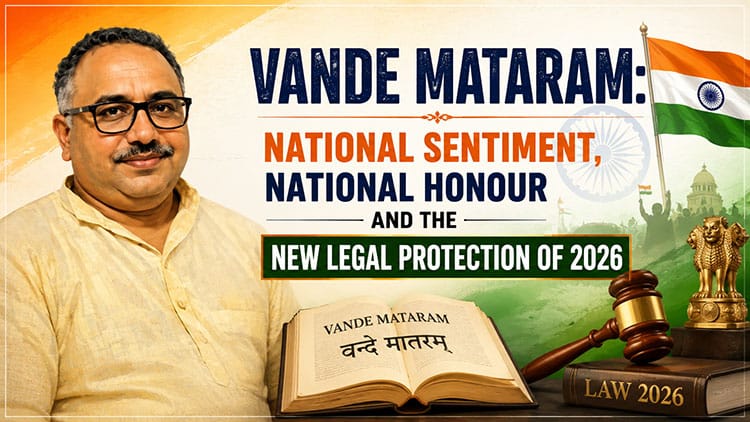
This distinction is particularly important after the 2026 amendment to the Prevention of Insults to National Honour Act, 1971.
The amendment has brought the National Song, Vande Mataram, within the protection of Section 3. Deliberately preventing the singing of the National Anthem or National Song, or deliberately causing disturbance at an assembly engaged in such singing, can attract punishment. For a first conviction, the punishment may extend to three years’ imprisonment, or fine, or both.
There is, however, an important legal point that must not be misunderstood.
It does not mean that every person who does not sing Vande Mataram will automatically be sent to prison for three years. The statutory offence concerns intentional prevention or disturbance. Therefore, simply remaining silent and deliberately preventing others from singing are not necessarily the same thing in law.
Patriotism does not require an exaggerated interpretation of the law. True respect for the nation also requires us to understand and respect the law correctly.
The 2026 amendment is nevertheless historically significant. Vande Mataram now has specific statutory protection under Section 3 along with the National Anthem. This does not make Vande Mataram the National Anthem. Jana Gana Mana remains the National Anthem, while Vande Mataram remains the National Song.
The Ministry of Home Affairs has also issued new directions concerning the official singing and presentation of Vande Mataram. Thus, in 2026, the subject is no longer merely an emotional or political controversy. It involves history, literature, national symbols, official protocol and statutory protection.
Therefore, deliberate insult, contempt or obstruction of Vande Mataram cannot simply be treated as an ordinary disagreement about a song. Respect for national symbols is an important part of democratic civic culture.
However, terms such as “mental Naxalism” or “separatism” should also be used carefully. A person should not automatically be labelled a Naxalite or separatist merely because he or she does not sing a song or expresses a religious concern. Such labels become meaningful only when there is broader evidence of activities such as violence against the constitutional order, active separatist politics or other concrete anti-national conduct.
The stronger national argument, therefore, is this:
A deliberate attitude of insulting, obstructing or degrading national symbols should never be normalised or celebrated as a political culture.
Bharat’s democratic system allows disagreement. But disagreement is not the same as disruption. Criticism is not the same as insult. Religious sensitivity is not the same as anti-nationalism. And patriotism is not the same as religious uniformity.
The real strength of Vande Mataram lies precisely in this broader meaning.
It addresses the Motherland of Bharat. It expresses reverence for the land for which freedom fighters went to prison, faced lathis and bullets, and sacrificed their lives.
Its national meaning is larger than any political party, contemporary leader or individual community.
From its literary beginnings in the nineteenth century, through the Swadeshi Movement of 1905, the debates of 1937, the Constituent Assembly decision of 24 January 1950, and finally the new statutory protection of 2026, the journey of Vande Mataram shows that it has become a living part of Bharat’s national memory.
Therefore, the need today is not to blame any particular community. The need is to understand the meaning of national symbols correctly.
Faith has its place. Disagreement has its place. Law has its place. But respect for the Motherland also has its place.
Without asking any Indian about his or her method of worship, we can still say: Respect the land that gave you birth. That is one of the broadest national meanings of Vande Mataram.
The message of the 2026 law should also be understood in this context: deliberately preventing the singing of the National Song or causing legally relevant disturbance during its singing is now punishable under the amended law.
Therefore, while discussing Vande Mataram, we should neither hide history, nor mock religious sensitivities, nor normalise deliberate disrespect towards a national symbol.
Bharat Mata does not belong to any one community. The Motherland belongs to the entire nation. To reduce respect for the Motherland merely to a matter of personal religious identity is to weaken the shared national consciousness that binds citizens together.
In this sense, Vande Mataram is not merely a song. It is a memory of freedom, a salutation to the Motherland, an expression of self-respect and a historic symbol of national consciousness.
VANDE MATARAM 🇮🇳