
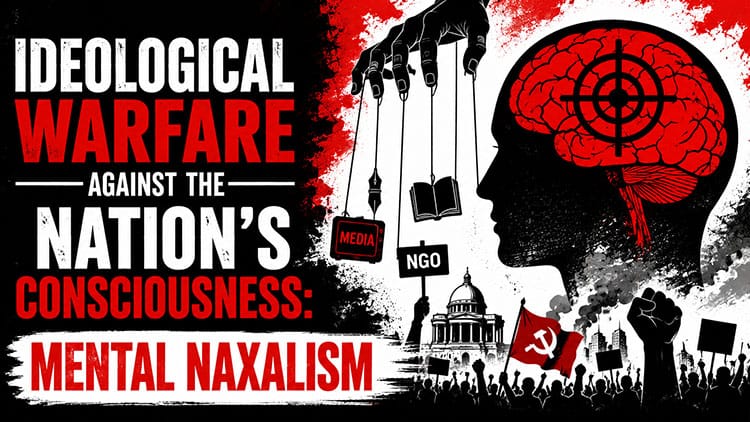
Recently, on August 15, 2026, during the Independence Day celebrations, the Prime Minister of India expressed particular concern over the threat of “mental Naxalism.” His statement has once again brought this concept to the centre of public discourse and exposed an invisible yet extremely dangerous challenge facing the nation. It has also opened a new debate in India’s contemporary intellectual and ideological landscape. This is not merely a political statement, but a warning about an ideological war being fought from within India itself.
Unlike Naxalites who take up arms and resort to violence in the forests, the concept of “mental Naxalism” points towards those who operate from urban centres, academic institutions, media houses and in the name of civil society. Through the pen, words and intellectual discourse, they allegedly provide ideological nourishment to the same violent ideology. It is a sophisticated ideological structure that seeks to make violence emerging from the barrel of a gun socially acceptable by describing it as “people’s revolution” and “resistance.”
One of the most prominent characteristics attributed to “mental Naxalism” is the refusal to regard Naxalite violence simply as a crime. Instead, arguments are constructed around the “causes” and “circumstances” supposedly responsible for such violence. Its discourse is often framed in the language of “victims” and “exploitation.” Whenever a brutal attack is carried out against security forces, such acts are portrayed as the “compulsion of the people” or a “natural reaction against exploitation.” The mentality that celebrates the deaths of CRPF personnel in Sukma or describes their martyrdom not as the loss of soldiers but as a “revolutionary victory” is presented as a manifestation of this distorted discourse.
It is the same mindset that seeks to defend slogans such as, “How many Afzals will you kill? Every home will produce an Afzal,” in the name of freedom of expression. This is not merely a slogan; it represents an attempt to challenge the country’s judicial process and generate sympathy for terrorism. When notorious Naxalite commanders such as Hidma are portrayed as heroes, the alleged objective is to weaken the image of the state and its law in the eyes of the public while presenting Naxalites as messiahs.
This section of society is also accused of practising “selective sensitivity.” Any action taken by the state, whether for national security or for eliminating Naxalism, is portrayed as a violation of human rights. Those who mourned the execution of Ajmal Kasab and described it as a “legal killing,” and those who expressed anguish over India’s nuclear tests, are similarly presented in this discourse as part of the phenomenon of “mental Naxalism.” The alleged objective is to create distrust towards India, place the country’s constitutional institutions under suspicion and portray India as an “unsafe nation.”
Such ideological narratives are often constructed through the deliberate alteration of language. Describing Naxalite attacks as “resistance,” violent conflict as a “people’s movement,” and Maoists as “revolutionaries” or “rebels” forms an important part of this vocabulary. It is a linguistic framework through which violence is allegedly glorified. The effort, according to this argument, is to create an atmosphere of disorder in the country. Supporting slogans such as “India, you will be broken into pieces,” encouraging separatist sentiments among young people and promoting the idea of cutting the “Chicken’s Neck,” the narrow corridor connecting northeastern India with the rest of the country, are presented as elements of the same strategy.
Another characteristic attributed to this mindset is “institutional distrust.” The government, judiciary, armed forces, police and media are allegedly regarded as perpetually wrong, while only one’s own ideological group is considered legitimate. According to this view, democracy is used as a shield for disorder. When unable to influence public opinion through elections, such groups allegedly attempt to create pressure through crowds, block roads and generate unrest in the hope of acquiring political power. This is not democratic dissent, the argument goes, but the use of democracy as a vehicle for disorder. Such forces target institutions that work to bind the nation together.
Their opposition, according to the article, extends to symbols of national pride. Not observing Kargil Vijay Diwas because it might upset a particular vote bank, or disrespecting the national anthem, are cited as examples of this alleged anti-national mindset. Going abroad and questioning India’s democratic system, and attempting to portray the country negatively on international platforms, are likewise described as part of the same “mental Naxal” agenda.
Advocating the restoration of the Indus Waters Treaty or constantly pressing for dialogue with Pakistan, while simultaneously conducting propaganda against anti-Naxal operations within India, is presented as evidence of a double standard. The argument is that such an approach serves not India’s welfare but the objective of weakening the country. When a prominent public figure proudly declares, “I am proud to be a mental Naxal,” it is portrayed not merely as disagreement with the government, but as an explicit identification with and association with a violent and anti-India ideology.
“Mental Naxalism” is not an external threat; it is an ideological malaise that develops within the country itself. This ideology, according to the argument, uses genuine issues such as poverty, exploitation and deprivation to advance its agenda. Therefore, the solution cannot be limited merely to action by security forces. It is equally necessary to identify the ideological foundations of such thinking and dismantle them through reasoned argument.
If India is to remain secure and united, recognising and exposing the mindset described as “mental Naxalism” is one of the major national necessities of our time. It is a form of intellectual terrorism that can be more dangerous than a bullet because it attacks the consciousness of the nation. Those who sympathise with criminals such as Kasab and extend support to forces seeking to divide the country must be exposed for what they are. The unity, dignity and security of the nation must remain paramount, and no ideology can be permitted to undermine that unity.