
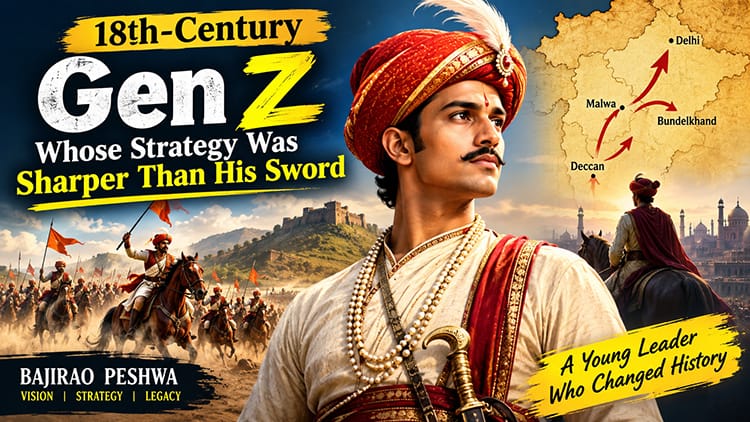

Today, we generally regard the age of 20 as the beginning of adulthood. Studies, career, friends, entertainment, social media, and the search for a future are all a normal part of life at this age. But if we travel back nearly three hundred years, we find a young man of roughly the same age shouldering a responsibility that required not merely talent, but also strong values, discipline, political understanding, and extraordinary courage. He was about 20 years old, and his position was that of Peshwa of the Maratha state. His name was Bajirao Ballal.
Bajirao was born on 18 August 1700. His father, Balaji Vishwanath, was an influential Peshwa of the Maratha state. After Balaji Vishwanath’s death in 1720, Chhatrapati Shahu appointed his son Bajirao as Peshwa. Bajirao was only about 20 years old at the time. It was not an ordinary decision. He had opponents at court, and entrusting such enormous responsibility to someone so young was itself a bold political decision.
But it is important to understand that Bajirao did not suddenly become a leader at the age of 20. He had been prepared for political and military responsibilities from childhood. By accompanying his father on military campaigns, he had the opportunity to closely observe the court, diplomacy, military activities, and changing political circumstances. These experiences later became the foundation of his decision-making.
Today, at the age of 20, a person is generally searching for direction in life. Bajirao faced an entirely different situation. He had to protect the Maratha power, expand its influence, and confront powerful forces such as the Nizam in the politics of the Deccan.
The most famous example of Bajirao’s military brilliance is the Battle of Palkhed in 1728. Opposing him was Nizam-ul-Mulk, a formidable political and military power. Instead of getting drawn into a prolonged direct battle, Bajirao made speed, geography, and logistics the foundation of his strategy.
According to the Maharashtra Government Gazetteer, Bajirao repeatedly changed his routes to divert the Nizam’s movements and eventually manoeuvred the Nizam’s army into difficult terrain around Palkhed, where obtaining supplies and reinforcements became extremely difficult. On 25 February 1728, Bajirao surrounded the Nizam, and on 6 March, the Treaty of Mungi-Shevgaon was concluded.
The importance of the Palkhed campaign lies not merely in Bajirao’s defeat of a powerful rival, but in the method of warfare he employed. He demonstrated that having a large army alone was not enough. If an enemy’s movement, supplies, and direction could be controlled, even superior numbers and resources could be rendered ineffective. Bajirao’s sword was swift, but his ability to understand warfare and turn circumstances to his advantage was even swifter.
After the success at Palkhed, Bajirao’s activities expanded further. In 1728, a campaign towards Malwa was undertaken. The Maharashtra Government Gazetteer records that Bajirao advanced through one route while his brother, Chimaji Appa, took another, helping strengthen Maratha influence in Malwa. Chimaji Appa’s victory at the Battle of Amjhera further advanced this process.
Bajirao’s role also became prominent in Bundelkhand. Maharaja Chhatrasal, facing pressure from the Mughal commander Muhammad Khan Bangash, sought Bajirao’s assistance. Bajirao arrived with his forces, intervened militarily, and helped rescue Chhatrasal from the crisis. Maharashtra’s official historical accounts associate this campaign with the events of 1729.
These campaigns make it clear that Bajirao’s politics were not confined to winning battles. He sought to build a wider foundation for Maratha influence by establishing relationships with different regional powers.
The most audacious demonstration of Bajirao’s strategic vision came during the Delhi campaign of 1737. The Maratha army advanced rapidly into northern India and reached the vicinity of Delhi. This was more than a military expedition. It was a sign of the changing political balance, in which the central authority of the Mughal Empire was weakening and the Maratha power was emerging as a major force in North Indian politics.
Young Bajirao’s vision went beyond the conventional political boundaries of his time. He was not merely looking at whom he needed to fight that day. He was looking at where the centre of power would be in the future. Between 1720 and 1740, under his leadership, the Maratha power expanded beyond the Deccan and strengthened its presence in the politics of Malwa and northern India.
This is where Bajirao’s story becomes relevant to contemporary society. His talent was extraordinary, but talent alone does not make someone Peshwa at the age of 20. Behind him were family, education, training, and an environment that cultivated responsibility.
Bajirao grew up in a political environment. His father was himself the Peshwa. He witnessed military campaigns, learned to understand political negotiations, and gained first-hand experience of military affairs. Historical sources from Maharashtra also connect his early life with this kind of training and experience. In today’s language, one could say that he had been taught to shoulder responsibility from childhood.
This raises a larger social question through Bajirao’s story. How much independence do we give our children and young people, and how much responsibility do we teach them to carry? We teach them about their rights, but do we give equal seriousness to an understanding of their duties? We prepare them for success, but do we also prepare them to make difficult decisions?
The term “Gen Z” here simply points to a particular age group. The generation we associate today with Gen Z is roughly the same age group in which Bajirao took charge as Peshwa. His story is valuable because it shows that when youthful energy receives direction, it can change the course of history.
Bajirao’s life was not a long one. He died on 28 April 1740, at the age of about 40. Yet his twenty-year tenure as Peshwa, from 1720 to 1740, changed the direction of Maratha power. After his death, his son Balaji Bajirao became Peshwa and carried the process of Maratha expansion forward.
Nearly three hundred years ago, a young man of 20 became Peshwa. He understood the politics of his time, challenged conventional methods of warfare, and helped take Maratha power from the Deccan towards northern India. His age was similar to that of today’s young generation, but his values and upbringing ensured that age did not become a limitation. That, perhaps, is the greatest lesson of Bajirao’s success, and one that today’s youth can carry forward.