
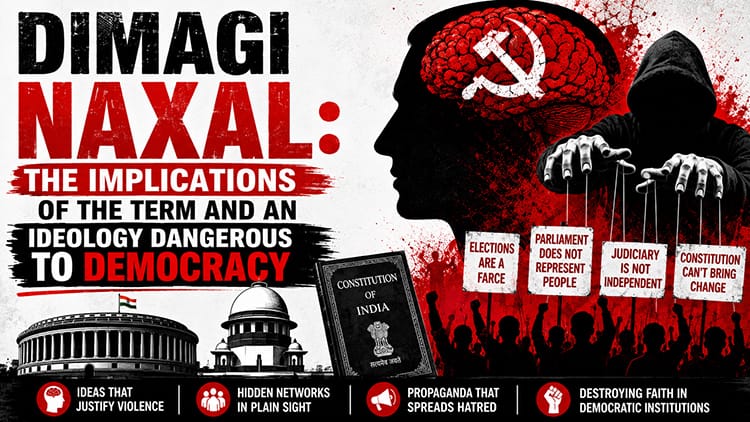

An armed Naxalite can be seen, but Naxalism existing as an ideology can pose a far more complex challenge to democracy. On August 15, 2026, Prime Minister Narendra Modi used the term “intellectual Naxal” from the ramparts of the Red Fort, drawing the nation’s attention to an aspect of Naxalism that generally receives less attention in discussions about security operations. The Prime Minister said that the country had succeeded in eliminating armed Naxalites from the forests, but that “intellectual Naxals” still existed, were waiting for opportunities, and were looking for avenues to promote violence and anarchy.
The statement is significant because if armed Naxalism is being decisively weakened, the next question naturally arises: Has its ideology also disappeared? If not, in what form does it survive, and what potential threat does it pose to democratic India?
From Four Decades of Challenge to a Decisive Turning Point
Naxalism is not a recent problem in India. The armed revolutionary ideology that emerged from Naxalbari gradually established roots in several tribal and forest regions of the country. Successive central and state governments struggled with the challenge for decades. Therefore, it would be an oversimplification of history to say that any one government created Naxalism or that any one government eliminated it. Security operations, development programmes, surrender and rehabilitation policies were pursued under different governments.
Yet it is also a fact that Naxalite violence was at its peak around 2010. According to Ministry of Home Affairs data, there were 2,213 incidents of Left-Wing Extremism in 2010, resulting in 1,005 deaths. In 2014, the number of incidents fell to 1,091 and deaths to 310. The decline accelerated thereafter. In 2024, incidents had fallen by 81 percent from the 2010 level to 374, while deaths of civilians and security personnel had declined by 85 percent to 150. The number of affected districts also fell from 126 to 38.
These figures make it clear that the geographical and violent influence of Naxalism has contracted dramatically. Several factors contributed to this, including action by security forces, improved intelligence, expansion of roads and communications, development programmes, Centre-state coordination, surrender and rehabilitation.
Nevertheless, the political determination displayed by the Modi government to decisively eliminate this challenge is significant. The government treated Naxalism not merely as a law-and-order problem but as a challenge involving both national security and development. Along with security operations, emphasis was placed on roads, telecommunications, financial inclusion, skill development and expanding the reach of administration.
It would therefore be more factually accurate to say that the firm political resolve of the Modi government, combined with sustained security and development operations at the Centre and state levels, played an important role in decisively weakening Naxalism. Bringing a decades-old problem to such a decisive turning point is certainly a major achievement.
But Was Naxalism Only in the Forests?
Naxalism is not merely about guns. It also has a political ideology behind it. According to the Ministry of Home Affairs, CPI (Maoist) follows an ideology aimed at capturing state power through armed rebellion, and the organisation and its organisational structures are banned under the Unlawful Activities (Prevention) Act.
An armed Naxalite is a relatively clear target for security agencies. But if someone does not carry a weapon yet provides ideological support to an ideology that seeks to overthrow the democratic system, identifying that person becomes much more difficult.
This is the serious dimension of the concept of “intellectual Naxal.”
The Threat of Weakening Democracy from Within
Democracy is not merely about elections. The Constitution, Parliament, judiciary, independent institutions, freedom of expression and peaceful transfer of power form its foundation.
If a persistent narrative is created that elections are merely a sham, Parliament does not represent the real voice of the people, the judiciary is not independent, the Constitution cannot bring about meaningful change, and every government is fundamentally against the people, public faith in democratic institutions can gradually weaken.
Once people begin to lose faith in the possibility of achieving change through democratic means, the ground for anarchy and violent politics can become fertile.
This is why it would be incomplete to view the Maoist strategy merely as an armed struggle taking place in forests. The Ministry of Home Affairs has stated that CPI (Maoist) has sought to mobilise people in semi-urban and urban areas through front organisations. Government documents have alleged that such organisations have been involved in propaganda, recruitment, raising funds and providing assistance to underground cadres.
Here a difficult question arises:
Is the person visible at the forefront always the actual driver of the entire activity?
Students may protest over fees, employment or education. Farmers may raise their voices over crops and prices. Tribals may struggle over land, forests and displacement. Workers may protest for employment and rights. These issues may be genuine, and their grievances may be legitimate.
But if a banned violent ideology attempts to exploit such genuine grievances for a broader political objective, the issue is no longer merely about the demands of the movement. The question becomes whether a hidden ideological network is attempting to divert that discontent away from democratic solutions towards permanent distrust of the system and violent political change.
This is what makes the concept of “intellectual Naxalism” a serious issue.
Someone in Front, Someone Else Behind?
The Ministry of Home Affairs has stated in Parliament in the past that the banned CPI (Maoist) had attempted to expand its activities in urban areas through overground front organisations. Government documents have alleged that such organisations assisted underground cadres by providing safe locations and supplies, spreading propaganda and attempting to weaken the security apparatus.
This does not mean that every student movement, farmers’ movement or tribal movement is Maoist. Such a conclusion would itself be dangerous for democracy.
The question is not about the movement. The question is about its objective and the network behind it.
If a genuine social problem is raised and a democratic solution is sought, that is democracy. But if the same problem is used to argue that “elections are useless,” “nothing can be achieved through Parliament,” “the Constitution is an instrument of exploitation,” and therefore violent struggle is the only option, the matter has moved beyond a demand for social justice.
The fundamental problem with Maoist ideology is precisely that it ultimately advocates capturing state power through armed struggle.
Therefore, continuously portraying democratic institutions as illegitimate and attempting to channel public discontent towards violent political transformation can become a serious national security challenge.
The Challenge of Political Protection
The matter becomes even more complicated when political parties enter the picture.
In a democracy, political parties have every right to support public movements. Therefore, merely supporting a movement cannot be treated as proof that a political party supports Maoism.
However, if a genuine organisational, financial, propaganda-related or other form of relationship with a banned violent organisation is established through evidence, political identity cannot place anyone above the law.
This creates a twofold challenge for the government. On the one hand, it must prevent genuine Maoist networks from receiving political protection, ideological support or social legitimacy. On the other hand, it must ensure that political dissent is not automatically treated as a national security offence.
If every critic of the government is labelled an “intellectual Naxal” and every protest is described as a “Maoist conspiracy,” identifying genuine Maoist networks would itself become more difficult. Therefore, evidence and law, rather than political allegations, must remain the yardstick.
Questions After the Prime Minister’s Statement
Political reactions followed the Prime Minister’s statement. Congress leader P. Chidambaram sarcastically expressed pride in being called an “intellectual Naxal.” Union Minister Kiren Rijiju, on the other hand, clarified that the Prime Minister’s remarks were not directed at opposition leaders. He interpreted “intellectual Naxals” in the context of people associated with Maoism, anti-Constitutional and separatist ideas.
The controversy highlights the need to clearly define the limits of the term “intellectual Naxal.” It is not a separate legal category, but a political and ideological expression. Therefore, before placing any individual in this category, their ideas, organisational associations, activities and available evidence must be examined.
The Next Challenge Before the Government
The state has security forces, laws, intelligence agencies and the judicial system to deal with armed Naxalism. But ideological extremism is more complicated.
An ideology cannot be defeated through repression alone. It must be countered with better ideas, facts, education, development and stronger democratic confidence.
If an individual genuinely assists the activities of a banned Maoist organisation, the law should take its course. If someone supports Maoist violence, their arguments should be countered with facts. But if someone is merely a critic of the government, they must retain the full democratic right to express their views.
This clear distinction is essential for making the fight credible.
The Next Battle After Naxalism
One of the major achievements during the Modi government’s tenure has been the dramatic reduction in the geographical and violent capacity of an armed movement that affected large parts of India for decades.
The challenge now is not merely to remove guns from the forests. It is also to ensure that the ideology that produced violence does not revive in new forms within democratic society.
This is the most serious implication of Prime Minister Modi’s use of the term “intellectual Naxal.”
An armed Naxalite is visible and can be confronted by security forces. But if someone attempts to create distrust in democratic institutions and sympathy for a violent ideology through ideas, propaganda, networks or political influence, identifying that person is far more difficult.
Clearing the forests of Naxal violence is a major achievement. The next great test is to ensure that no ideological ground remains within democratic society from which the same violent ideology can rise again.
But one boundary must never be forgotten. Democratic dissent cannot be eliminated in the name of protecting democracy. Drawing a clear line between genuine Maoist ideological networks and ordinary political dissent will be the greatest test of this struggle.
Because ultimately, democracy has to be protected not only from guns but also from ideas that justify the use of guns. And the strongest instruments for protecting democracy remain democratic freedom, the Constitution and the rule of law.