

Civilizations refine themselves through memory. These memories are not merely records of the past; they are living repositories of experience that travel across generations. Stories of resolve and fulfillment, of struggle and triumph, have been preserved in humanity’s collective consciousness since time immemorial. It is from these memories that faith draws its life giving strength.
Throughout history, forces opposed to human values have continually sought to weaken this immortal reservoir of cultural memory. The conflict between Kadru and Vinata, the wars between the Devas and the Asuras, the exile of Lord Rama, and the betrayal of the Pandavas by the Kauravas are not merely mythological episodes. They are enduring lessons preserved in India’s civilizational memory.
Yet this is the land of self realized sages. India’s philosophical tradition has always inspired its people with the confidence that they are “Amritasya Putrah”, the children of immortality. Generation after generation has repeated the Vedic proclamation, Amritasya Putrah Vayam. It is this spiritual confidence that has enabled Indian civilization to survive countless adversities.
When Prince Rama was invited to ascend the throne but instead sent into exile, Queen Kausalya did not surrender to despair. Rather, she blessed her son by recalling an even older memory. She prayed that the same auspicious grace which Mother Vinata had invoked for Garuda when he departed to bring the nectar of immortality might also protect Rama on his journey. Such references reveal a civilization whose strength lies not merely in history but in its ability to draw courage from sacred memory. It is this consciousness that has sustained India through innumerable trials.
Yet the struggle between noble and destructive forces never truly ends. No battle between the Devas and the Asuras is ever the final one. Ages change, stories change, circumstances change, but the essential nature of conflict remains the same. Forces of disruption continue to exist, adapting themselves to every age.
India is once again witnessing such a moment.
A regrettable incident involving the management of donation funds at the Shri Ram Janmabhoomi Temple has been transformed by vested interests into an assault on public faith itself. Those who had been left disheartened by the consecration of Shri Ram Lalla at Ayodhya seized upon this isolated incident as though the sky itself had collapsed. Like frightened rabbits imagining disaster, political opportunists began running with exaggerated claims, and much of the media followed the same panic without pausing to examine the facts.
Soon an atmosphere of grief, distrust, accusation, and political blame engulfed public discourse. It appeared as though society had momentarily forgotten its own spiritual identity and inner strength.
Instead of joining the panic, we must pause and ask a simple question. Has the sky really fallen? And even if someone insists that it has, where exactly are those spreading panic leading us by asking us to flee? The frightened rabbit is only a metaphor. We are not rabbits. Every alarming voice does not deserve unquestioning belief. A mature society must possess the wisdom to distinguish truth from hysteria and courage from fear. Only such discernment can overcome panic.
The reconstruction of Shri Ram Janmabhoomi was the culmination of centuries of struggle. For millions of Indians, it represented not merely the construction of a temple but the restoration of a civilizational memory. Naturally, the nation celebrated this historic moment with immense joy.
There were, however, those who could never reconcile themselves with this celebration. Goswami Tulsidas had aptly observed, “Chorahin Chandini Rati Na Bhava”. Just as thieves dislike the brightness of a moonlit night, those uncomfortable with the resurgence of India’s civilizational confidence remained restless. They attempted to manufacture controversy at every stage. Questions were raised about the timing of the consecration, the architectural choices, the list of invited guests, and countless other issues.
The nation witnessed all these attempts.
Yet the bond between Lord Rama and the people of India transcends every political calculation. Devotees poured into Ayodhya from every corner of India and from across the world. The Ram Temple established new benchmarks of faith, cultural pride, and national consciousness. It became not merely a place of worship but a symbol of India’s enduring civilizational identity.
To understand the present controversy surrounding the Shri Ram Temple in Ayodhya, it is necessary to first appreciate the extraordinary circumstances in which the institution has been functioning. The reconstruction of Shri Ram Janmabhoomi was not merely the completion of a long awaited temple. It marked the creation of an entirely new institutional framework, one for which there existed no modern precedent.
No contemporary temple in India had ever been required to manage such an unprecedented scale of pilgrimage, donations, construction activity, security arrangements, and public expectations simultaneously. Even before the temple complex and its administrative systems had fully matured, an unfortunate incident came to light. Preliminary indications suggested that a few employees engaged in counting and handling offerings deposited in the donation boxes had misappropriated part of the donated funds.
According to the author, the temple administration immediately took cognizance of the matter, sought assistance from the civil administration, identified those allegedly responsible, recovered the amount in question, and initiated corrective measures. Rather than publicizing the incident before completing the necessary investigation, the authorities chose to focus on resolving the issue through established legal and administrative procedures.
Before the matter could reach its formal conclusion, however, it acquired an entirely different dimension in the political arena. What began as an instance of alleged misconduct by a handful of individuals was, in the author’s view, transformed into a broader political controversy.
The management of a religious institution is ordinarily accountable to legal and administrative processes rather than political rhetoric. For this reason, the temple authorities initially refrained from responding publicly to every allegation. Their restraint, however, was interpreted by many critics as evidence of fear, concealment, or guilt.
Those who, in the author’s opinion, had been deeply unsettled by the establishment of the Ram Temple now entered the public debate with renewed intensity. Expressions such as “stolen donations” and “misappropriated temple offerings” rapidly became recurring slogans across sections of political discourse and television debates.
The author expresses particular disappointment with sections of the mainstream media. Institutions that had extensively covered the construction and consecration of the Ram Temple now appeared unwilling to wait for verified facts before drawing sweeping conclusions. In the race for dramatic headlines, measured language often gave way to sensational expressions. Terms such as embezzlement, large scale fraud, looting, and corruption began circulating widely, even before the official investigation had reached its conclusion.
As these narratives spread, many devotees who had contributed generously toward the construction of the temple began expressing anxiety. Some even demanded detailed accounts of their individual donations. For the author, this represented one of the most painful aspects of the controversy. The alleged theft committed by a few individuals was understandable as an instance of personal moral failure. What appeared far more troubling was the speed with which public confidence itself became vulnerable to suspicion.
The author argues that powerful public narratives possess the ability to transform isolated events into sweeping judgments. A crime committed by individuals can easily be projected as a failure of an entire institution, or even as evidence against the faith that the institution represents. While many people continued to maintain confidence in the temple administration, their voices, according to the author, either remained subdued or received comparatively little attention in public discourse.
Thus, what had begun as an allegation involving a limited number of employees gradually evolved into a nationwide debate about trust, accountability, and the symbolic significance of the Ram Temple itself.
In a world shaped by constant political contestation, the author argues that faith remains one of the few enduring forces capable of holding society together. When that faith becomes so fragile that every allegation is accepted without patience or reflection, society, he suggests, must pause and examine its own state of mind.
The alleged theft of donations at the Shri Ram Temple, the author writes, was not simply the misappropriation of money. Donations offered at a place of worship are expressions of devotion and trust. Any attempt to steal them is therefore not merely a financial offence but also a betrayal of the sentiments of countless devotees. Those responsible, the author maintains, deserve the strictest punishment permitted by law.
At the same time, he distinguishes between the criminal actions of a few individuals and the credibility of an entire institution. According to him, treating the misconduct of certain employees as proof that the temple itself or its administration has lost public trust amounts to a far greater injustice than the original crime. Throughout the weeks following the incident, political figures, television commentators, and self proclaimed spokespersons repeatedly used the controversy to advance their own narratives. The author considers this deeply unfortunate.
Every profession, he observes, is naturally influenced by its own interests and incentives. Yet journalism, politics, and public life also carry ethical responsibilities. In his opinion, those responsibilities were often overshadowed by the desire for sensationalism and political advantage.
The author notes that, at the request of the Shri Ram Janmabhoomi Teerth Kshetra Trust, the Government of Uttar Pradesh constituted a Special Investigation Team to conduct a detailed inquiry into the matter. The Trust itself also reviewed the incident in its meetings, introduced corrective measures, addressed the concerns of donors, and reorganized certain aspects of its administration. Following the resignation of two members on moral grounds, new members were inducted into the Trust as part of its efforts to strengthen institutional accountability.
Viewed from this perspective, the author argues, the controversy should be understood primarily as an administrative lapse requiring investigation, correction, and institutional reform. However, he believes that the political campaign built around the incident went far beyond legitimate criticism. In his view, what followed was not merely scrutiny of an administrative failure but an attempt to damage the credibility of the temple itself and weaken the faith associated with it.
The author further argues that individuals and groups who had long questioned the historical and cultural significance of Shri Ram Janmabhoomi suddenly began presenting themselves as guardians of the temple’s moral standards. He regards this as a contradiction that raises important questions about political motivation.
The article concludes with a powerful metaphor. A dust storm, the author writes, may temporarily darken the sky, but dust cannot permanently conceal the vastness above it. Eventually, rain falls, the dust settles back upon the earth, and the sky regains its natural clarity.
The greater concern, according to the author, is not the storm itself but the uncertainty that it creates among those who should possess confidence in their own convictions. He urges devotees and the wider Hindu community to reflect upon this moment, to distinguish between genuine institutional shortcomings and politically amplified narratives, and to respond with patience rather than panic.
For the Shri Ram Janmabhoomi Teerth Kshetra, the incident also serves as an important lesson. Building a magnificent temple is only one part of its responsibility. Preserving transparency, public trust, administrative integrity, and moral credibility is equally essential. According to the author, those who could not prevent the physical reconstruction of the temple may continue attempting to undermine its symbolic and emotional significance. Such challenges, he suggests, must be met through stronger institutions, greater accountability, and unwavering commitment to ethical conduct.
The article closes with a symbolic reminder drawn from Hindu mythology. Before the gods could partake of the nectar of immortality, they first had to identify Rahu, the deceptive force hidden among them. Likewise, the author concludes, every institution must remain vigilant against those who seek to exploit its weaknesses. Only through integrity, transparency, and collective responsibility can both the institution and the faith it represents continue to command the confidence of society.
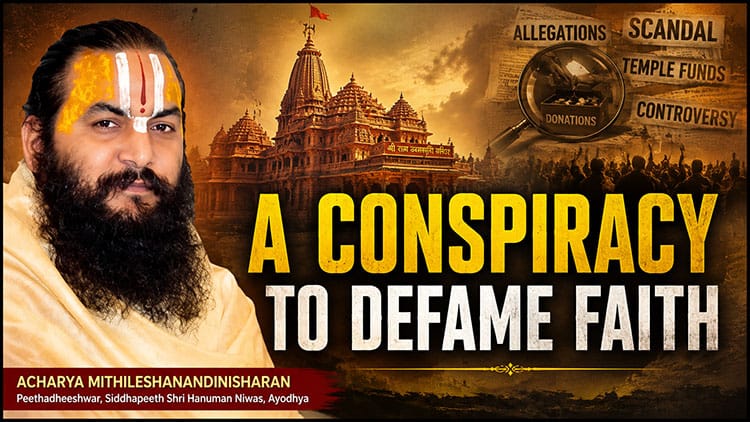
Acharya Mithileshanandinisharan
Peethadheeshwar, Siddhapeeth Shri Hanuman Niwas, Ayodhya