

No matter how deeply Hindu society reveres the cow as Gau Mata, in the eyes of the law she ultimately remains an animal. Like any other livestock, she is often viewed merely as a milk yielding creature and, once considered economically unproductive, as an animal that may be slaughtered. Such is the reality of a country that defines itself as secular rather than as a Hindu nation.
What difference does it make that Hindu tradition regards the cow as the abode of all deities and, from a scientific perspective, as one of nature’s greatest gifts to humanity? For those who do not share this worldview, a cow is simply livestock, and livestock, they argue, exists for human use, including slaughter.
There is another side to this debate as well. For many, a cow represents meat, leather, bones, blood, and commercial value. It is an economic commodity capable of generating substantial profit. If Hindus choose to worship the cow, some even view its slaughter as an ideological assertion against that belief.
Although this debate exists in several parts of India, recent developments in Tamil Nadu raise particularly important questions.
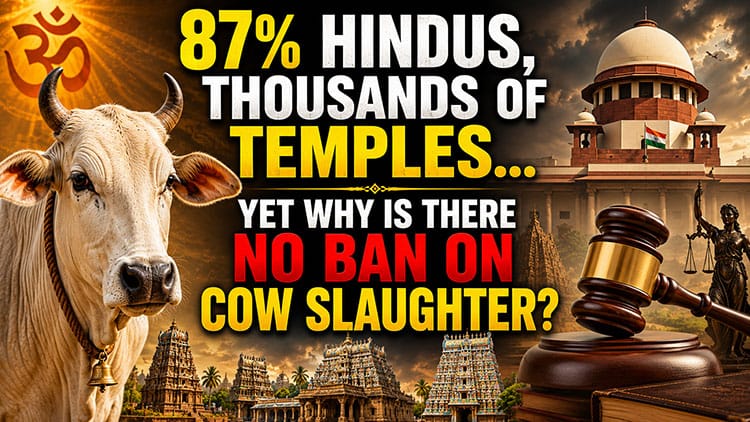
According to the 2011 Census, Hindus constitute 87.58 percent of Tamil Nadu’s population, amounting to approximately 63.1 million people. Christians form the second largest religious community with 6.12 percent of the population, while Muslims account for 5.86 percent. Jains constitute about 0.12 percent, and the remaining 0.32 percent belong to other faiths or did not specify their religion.
Equally striking is another statistic. The Hindu Religious and Charitable Endowments Department administers 38,615 temples across Tamil Nadu. If village shrines, privately managed temples, and local places of worship are included, the total number exceeds 79,000 temples. Nearly 33,000 of them are estimated to be between 800 and over 2,000 years old. Approximately 68 percent are dedicated to Lord Shiva, while the remainder are devoted to Lord Vishnu, Murugan, and various forms of the Divine Mother.
Tamil Nadu is also home to some of India’s most magnificent temples, including the Sri Ranganathaswamy Temple at Srirangam, one of the largest functioning temple complexes in the world, and the UNESCO World Heritage Brihadeeswarar Temple at Thanjavur, built by the Chola dynasty. In many respects, the state represents one of the strongest living centers of Sanatana Hindu traditions, rituals, and temple worship.
Yet, despite this profound religious heritage, cows continue to be slaughtered, even though Hindu scriptures regard them as among the most sacred beings in creation.
Within the Sanatana tradition, the cow is revered not merely as an animal but as a symbol of divine presence, cosmic harmony, compassion, and sustenance. The Rig Veda describes the cow as Aghnya, meaning “one who should never be killed,” and venerates her as the universal mother.
The celebrated Vedic verse declares:
“Mātā Rudrāṇāṁ Duhitā Vasūnāṁ
Svasādityānām Amṛtasya Nābhiḥ.
Mā Gāmanāgām Aditiṁ Vadhiṣṭa.”
Rig Veda 8.101.15
Its meaning is that the cow is the mother of the Rudras, the daughter of the Vasus, the sister of the Adityas, and the very source of immortality. Therefore, no wise person should ever kill this innocent and blameless being.
The Yajur Veda likewise emphasizes that nothing in the world can equal the utility, sanctity, and value of the cow. It proclaims:
“Gostu Mātṛā Na Vidyate.”
Yajur Veda 23.48
In essence, the scripture teaches that the cow is beyond comparison and possesses immeasurable importance for human civilization.
The Atharva Veda further elevates the status of the cow by describing her as the very foundation of prosperity and abundance. It declares:
“Dhenuḥ Sadanam Rayīṇām.”
(Atharva Veda 11.1.34)
The verse conveys that the cow is the abode of material wealth, spiritual prosperity, and the sustaining force of civilization. According to the Vedic worldview, the nourishment provided by the cow through milk, ghee, and other natural products contributes to the well being of both society and nature.
The Mahabharata, particularly the Anushasana Parva, also devotes considerable attention to the spiritual significance of the cow. Bhishma Pitamaha narrates to Yudhishthira the divine origin of cows and their sacred place in dharma.
One of the verses states:
“Gāvo Mamāgrato Nityaṁ Gāvaḥ Pṛṣṭhata Eva Ca.
Gāvo Me Hṛdaye Cāpi Gavāṁ Madhye Vasāmyaham.”
Its meaning is:
“May cows always remain before me, behind me, and within my heart. May I forever dwell among them.”
The author interprets this as an expression of the exalted status accorded to the cow within the Hindu tradition.
The Bhagavad Gita also refers to the divine cow Kamadhenu while describing the manifestations of Lord Krishna.
“Āyudhānām Ahaṁ Vajraṁ
Dhenūnām Asmi Kāmadhuk.”
(Bhagavad Gita 10.28)
Lord Krishna declares that among cows He is Kamadhenu, the wish fulfilling celestial cow. The article points out that this symbolic association reflects the exceptional reverence accorded to the cow in Hindu philosophy.
The author further observes that numerous Puranas, Smritis, and other sacred texts similarly glorify the cow. One particularly meaningful example appears in the Chandogya Upanishad, where Sage Haridrumata Gautama instructs his disciple Satyakama Jabala to take four hundred weak cows into the forest and care for them until they multiply into a thousand.
Satyakama serves the cows with complete dedication for many years. During this period, he is said to attain spiritual wisdom through his close relationship with nature and the animals themselves. The story illustrates that service to the cow is presented not merely as physical care but as a path toward higher realization.
According to the author, ancient Indian literature contains countless such narratives celebrating the importance of the cow.
He then turns to the modern scientific perspective.
The article argues that contemporary scientific, medical, and agricultural research has increasingly examined the ecological and medicinal value of indigenous Indian cattle. Studies have explored the properties of cow’s milk, urine, dung, and other byproducts, suggesting that native Indian breeds may possess characteristics worthy of continued scientific investigation.
One area discussed is the distinction between A1 and A2 beta casein proteins found in milk. The article states that milk from many indigenous Indian cattle contains the A2 beta casein protein and refers readers to publications such as Keith Woodford’s Devil in the Milk and the review article “Review of the Health Effects of A1 and A2 Beta Casein Protein”, along with research published in the European Journal of Clinical Nutrition, as sources discussing this topic.
The author also discusses research concerning distilled cow urine (Gau Ark), stating that laboratory studies have investigated its antimicrobial properties and its potential role as a bio enhancer, a substance that may enhance the effectiveness of certain medicines. The article refers to patents granted to India’s Council of Scientific and Industrial Research (CSIR) relating to this area of research and argues that such studies demonstrate the medicinal potential of products derived from the cow.
From these examples, the author concludes that milk, curd, ghee, dung, and urine obtained from the cow possess continuing value even after the animal ceases to produce milk. In his view, the usefulness of the cow extends far beyond dairy production, making the argument for slaughter based solely on declining productivity both incomplete and inadequate.
The author argues that if the cow enjoys such profound religious, cultural, and even scientific significance, an important question naturally arises: why does a country where Hindus form the overwhelming majority still permit the slaughter of cows under certain legal circumstances?
According to the author, this question becomes especially compelling in the context of Tamil Nadu. More than 87 percent of the state’s population is Hindu, and it is home to some of the most magnificent and historically significant temples of Sanatana Dharma. Yet, despite this religious landscape, legal provisions continue to allow cow slaughter under specified conditions.
The article then turns to the recent legal developments that prompted this discussion.
It explains that the Supreme Court of India granted an interim stay on the operative portion of a Madras High Court order that had directed the Tamil Nadu Government to ensure that no cows or calves were slaughtered anywhere in the state on Bakrid or on any other day.
The High Court had earlier observed that cow slaughter was not an essential religious practice in Islam, referring to previous judicial decisions of the Supreme Court, and had directed the State Government to ensure complete enforcement of such a prohibition. Notices had also been issued to the concerned parties during those proceedings.
The Tamil Nadu Government subsequently challenged that order before the Supreme Court.
While hearing the Special Leave Petition, a Bench comprising Justice Vikram Nath and Justice Sandeep Mehta observed, at the prima facie stage, that the concluding portion of the High Court’s order requiring a blanket statewide prohibition appeared to require reconsideration. Consequently, the Supreme Court stayed the operation of that portion of the High Court’s judgment until further proceedings.
Appearing for the State Government, Senior Advocate Abhishek Manu Singhvi argued that the High Court’s directions were inconsistent with the provisions of the Tamil Nadu Animal Preservation Act, 1958.
He submitted that the Act permits the slaughter of cows above a specified age that are certified by the competent authority as permanently unfit for breeding or agricultural work. He further contended that other statutory provisions, including the Prevention of Cruelty to Animals Act, 1960, the Slaughter House Rules, 2001, the Tamil Nadu Urban Local Bodies Act, 1998, and related regulations, govern the regulation of animal slaughter but do not impose a complete prohibition. According to this argument, the High Court had travelled beyond the existing statutory framework.
The article notes that the Supreme Court has not delivered its final judgment. Until the matter is finally decided, the statewide prohibition directed by the Madras High Court will remain inoperative because of the interim stay.
The author concludes with a strongly worded opinion. He argues that it is deeply ironic that a state with an overwhelming Hindu majority, thousands of temples, and a long tradition of cow veneration is still unable, in his view, to ensure complete protection for the animal regarded as sacred in Hinduism.
In the closing passages, the author contrasts historical periods with contemporary India and expresses concern that, despite the country’s Hindu majority, secular constitutional and statutory frameworks continue to permit cow slaughter under specified legal conditions. He further suggests that many Hindus remain passive observers rather than active participants in the cause of cow protection, reserving their religious engagement primarily for ritual practices such as Godaan (the ritual donation of a cow) instead of broader efforts toward Gau Raksha (cow protection). These concluding remarks reflect the author’s personal opinion and interpretation of the issue.