

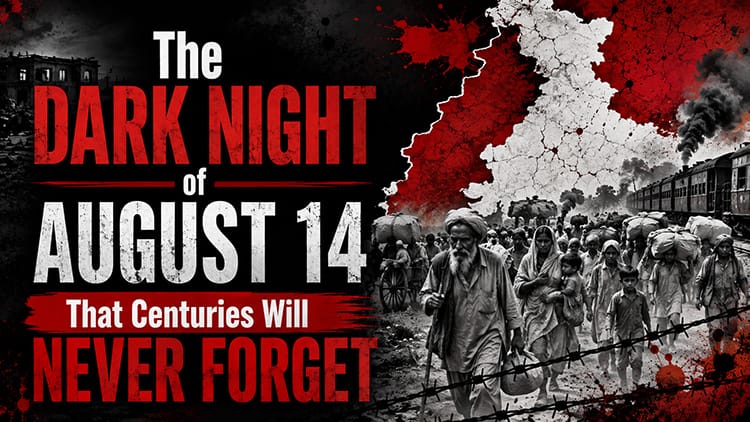

Some people went to sleep waiting to see the morning of independence. Little did they know that when they opened their eyes in the morning, their home would still be standing in the same place, but the country would have changed. What must that night of August 14, 1947, have been like? Imagine a house where children were sleeping. Perhaps a mother had fed them and put them to bed. Perhaps a father had gone to sleep on his cot, thinking about the work of the following day. Somewhere, crops standing in the fields would have been swaying in the breeze just as they had before. Somewhere, a shopkeeper would have been preparing for the next day’s business. In some homes, people would have been talking about independence. People knew that the British were leaving. But how many knew that their own homes, their own country, would also be taken away from them?
No one knew that the house in which they had lived for centuries would, by the time they woke up, be called part of another country. No one knew that a wall would suddenly be erected between them and the neighbour with whom they had shared joys and sorrows until the previous day. No one knew that they would have to flee the fields they had always regarded as their own simply to save their lives. And the most horrifying thing was that a line drawn on a map had inflicted wounds on human lives.
The story of a family living around Nankana Sahib still bears witness to that horrifying night. One member of the family, who was a teenager at the time, later came to India and recounted the story of his life. The village was predominantly Muslim. Initially, the family did not feel any particular danger. But as discussions about the creation of Pakistan began, the atmosphere started changing. Then that evening came. At around six o’clock, an attack took place. The family had to leave their home. Before long, their house was looted. That family had become refugees in their own village.
After this, the journey from Nankana Sahib to Firozpur began. Thousands of people were travelling in the caravan. There were bullock carts. There were children. There were women. There were elderly people. They carried whatever belongings they had managed to save. The road was long and danger awaited them at every step. The caravan remained halted for several days and then began moving again. It took nearly a month to reach the Indian border from Nankana Sahib. There were attacks along the way. Many people and carts became separated from the caravan. The caravan moved forward through the August rains. That scene remains alive in the memories of those who witnessed it. Rainwater was flowing, and in places, blood was flowing along the same road. This was not merely the story of one family. There were millions of such stories.
Sudharshana Kumari was only eight years old when Partition took away her childhood. Reading her story recorded in the oral history of the Partition Museum, Partition suddenly stops appearing as a political event and begins to be seen through the eyes of a little girl. One evening, she suddenly had to leave her home. Violence had spread around them. The family had to flee. Along the way, she saw her relatives and neighbours being killed. For some time, the family had to remain hidden. But the most poignant part of this story is not the description of violence.
It is a small tin box. In the ruins of an abandoned home, Sudharshana found a tin box. She picked it up. Why? Because her dolls had been left behind in Pakistan. She was thinking that when she reached India, she would get new dolls and this box would be useful for keeping them. Think about it. An eight-year-old girl’s home had been destroyed. Her family was fleeing for its life. Death and fear were all around her. But that little girl still had her dolls in her thoughts. Partition had taken away her home, but the childhood within her was still alive. Today, that tin box at the Partition Museum is a small but extraordinary testimony to that tragedy.
The memory of Jasvir Singh Bhatia contains another scene from Partition. He received word that the village was going to be attacked. His family hid in the fields. They had almost nothing to take with them. That night, the village was set on fire, and he watched his own home burn before his eyes. After that, they joined the huge caravans moving towards India. Along the way, hunger, disease and violence claimed the lives of thousands. Imagine a house burning. A house whose walls had witnessed a person’s birth. Where his mother had raised him. Where he had married. Where his children had been born. And then that same house turning into flames before his eyes. Partition did not merely force millions of people to leave their homes. Many people watched their homes burn and then did not even have the courage to look back.
The memory of Sahib Singh Virdi makes the journey of Partition even more horrifying. His father had a double-barrelled gun and some cartridges. People travelling in the caravan carried various crude weapons for self-defence. But on the way, armed men on horseback appeared and began attacking. People started running. The illusion of security within the caravan was shattered in an instant. This story brings to the surface the fear experienced by thousands of people who had left their homes and embarked on a journey whose destination they knew, but they did not know whether they would even survive long enough to reach it.
In the memories of Partition, trains became a symbol in themselves. At that time, the railway was not merely a means of transport. It was a lifeline carrying people to a new country. But many times, that same train became a carriage of death. The Partition Museum records the story of Surinder Singh. He was on a train that came under attack and he was hit by five bullets. He survived. At a Partition Horrors Remembrance Day event held in Ranchi in 2025, Partition eyewitness Balbir Dutt also shared his memories of those trains in which not passengers but corpses arrived. Today, when we board a train and reach one city from another within a few hours, it is difficult to imagine that the same train once represented a family’s final hope between life and death.
There is another pain in the story of Partition that did not receive enough attention for a long time. It is the story of women. When people were leaving their homes, they could not save all their property. Space was limited. The journey was unsafe. Under such circumstances, people had to decide what they could take with them. One woman saved a sewing machine. Someone carried brass utensils. Someone carried spices. Someone carried children’s clothes. And someone carried land documents or educational certificates. These small belongings tell the story of the world that people were leaving behind.
A woman who reached Lahore, whose story was later recorded in an interview by the Partition Museum, recalled that when they found an empty house, there were half-burnt rotis lying on the stove in its kitchen. The people who lived in that house had fled so suddenly that they had not even been able to finish cooking their food. How terrifying must that departure have been, when a person did not even have enough time to think about taking the food off the stove?
According to one woman, her family lived in the Arifwala region of present-day Pakistan. As violence intensified, the family had to leave. At that time, Anusuya was an infant. To save her from a mob engaged in looting and killing, she was hidden beneath quilts in a bullock cart. Her father wandered through hospitals and morgues searching for her. The family left behind their home, land and property and eventually spent years struggling to survive in refugee camps. A child had to be hidden beneath quilts simply to save her life. Could there be a more horrifying memory than this?
When they reached India, they had nothing in their hands. No house. No fields. No land. No business. No grain. No livestock. No childhood friends. Only their family and a few belongings. After reaching India, arrangements were made for refugees to receive food, clothing and shelter. Those who had cultivated their own land only the day before now had to begin their lives all over again.
Here began another chapter in the story of Partition. The chapter of rebuilding after being uprooted. Millions of people rebuilt their lives. Some opened small shops. Some found jobs. Some studied. Some started businesses. Some took their children far beyond the life they themselves had lost. But success did not erase memory.
When we talk about Partition, statistics often come before us. How many people were killed? How many were displaced? How much property was lost? How many people crossed the border? These numbers are important. But numbers have their limitations. The displacement of one crore people does not simply mean a figure of one crore. It means one crore homes being left behind.
One crore times, a mother’s courtyard was left behind. One crore times, a child left behind his favourite tree and toys. One crore times, someone met a neighbour for the last time. Someone’s shop. Someone’s temple. Someone’s gurdwara. Someone’s field. Someone’s school. Someone’s well. Someone’s childhood. Everything suddenly became history.
Was it only the partition of two countries? Perhaps not. It was also the partition of the trust that had taken generations to build. Yesterday, he was a neighbour. Today, he had become an enemy. Yesterday, people had drunk tea in his home. Today, they had to avoid him. Yesterday, children had played together in the village. Now religion had become their identity. And this is the deepest tragedy of Partition. Political boundaries were drawn, but the first casualty was human trust.
Today, when we remember August 14, we see the morning of independence before us. But for those millions of people, the picture of that morning was different. For some, independence had arrived. For some, Pakistan had been created. For some, India had become their new home. But for some, independence meant saying goodbye forever to their old home. Therefore, August 14 should not be viewed merely as a date on the calendar. It was the night when a political decision changed the course of millions of people’s lives.
A boundary was drawn without asking ordinary people for their consent. People had neither made the map nor decided the boundary. But they were the ones who paid the greatest price for that boundary. And therefore, when we remember that night, we should not ask only how India and Pakistan came into being. We should also ask how many homes were destroyed between them? How many childhoods were left behind along the way? How many mothers were separated from their children? How many children never saw their fathers again? How many women’s lives were changed forever? How many people stopped trusting their neighbours?
Today, the people of that generation are rapidly disappearing. They are the people who saw with their own eyes what we now read about in books. An elderly survivor once said in his account that in the coming years, perhaps very few people would remain who could tell the story of that time from what they themselves had witnessed. Therefore, their stories are not merely about the past. They are warnings. For every society. For every political system. For every generation.
Because hatred often begins very small. First, there is suspicion of a neighbour. Then his identity is questioned. Then he is considered different from oneself. And one day, the very neighbour with whom life had been shared until the previous day is declared an enemy.
As a man leaves his home, he looks back at it one last time and asks, “Will I ever be able to return?” Perhaps he continued to hope that he would. But history had already closed the door. That night of August 14 passed. Morning came. Two countries were created. But inside millions of people, that terrible night never ended. That is why the dark night of August 14 is not merely the story of Partition. It is the story of the price that ordinary people paid after a political decision, with their blood, their homes, their relationships and their memories. And perhaps that is why even today, reading the stories of Partition leaves the mind numb.