
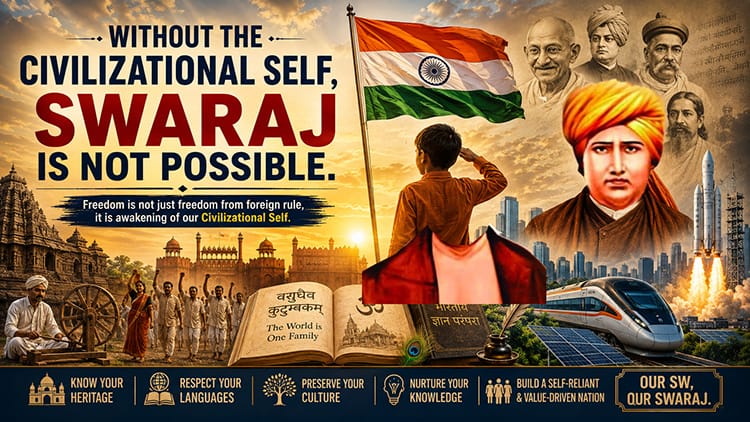
Every year on August 15, when the Tricolour flies proudly, the National Anthem resonates across the country and India celebrates Independence Day, our attention naturally turns to that historic midnight of 1947, when India broke the chains of colonial rule and began a new journey as an independent nation. Yet, Independence Day is not merely an occasion for celebration. It is also a day for introspection. It gives us an opportunity to ask ourselves whether freedom is merely a change of political power, or whether it carries within it a deeper national and civilizational meaning. The answer is clear: without the Civilizational Self, Swaraj is not possible.
In the Indian tradition, the Civilizational Self does not merely mean an individual’s ego or private existence. It signifies an awareness of one’s own being, one’s nature, culture, language, knowledge, history and values of life. In the broader national context, it means an awareness of who we are as a civilization. This is why the Indian understanding of freedom has been different from the Western political conception of liberty. In India, freedom begins with the awakening of the individual and expands towards society, culture and the nation.
That is why our thinkers spoke first of awakening the Civilizational Self and then of Swaraj. The Atmavidya of the Upanishads, the Swadharma of the Bhagavad Gita, Swami Vivekananda’s call for self-confidence, Lokmanya Tilak’s vision of Swaraj, Mahatma Gandhi’s Gram Swaraj, and Pandit Deendayal Upadhyaya’s philosophy of Integral Humanism can all be seen as connected by a larger philosophical thread. These ideas did not view the individual, society and nation as isolated entities, but as interconnected parts of a living whole. Their fundamental message was that if a nation forgets its Civilizational Self, political freedom alone cannot make it truly self-reliant and self-confident for long.
In 1947, we certainly achieved freedom from foreign rule. But did mental and cultural subjugation also end on that very day? This question remains as relevant today as it was at the time of Independence. If we regard our own languages as inferior, look at our history with suspicion, consider our knowledge traditions irrelevant, and understand development merely as the imitation of foreign models, then we must acknowledge that the journey towards Swaraj is still incomplete.
The freedom movement itself was evidence of this broader awakening. Mahatma Gandhi connected political freedom with social and economic self-reliance. The Charkha was not merely a means of producing cloth; it became a symbol of Swadeshi and self-reliance. Lokmanya Tilak, through the declaration, “Swaraj is my birthright,” transformed the idea of political rights into a matter of public consciousness. Sri Aurobindo connected nationalism with spiritual consciousness, while Swami Vivekananda worked to awaken self-confidence and self-awareness within Indian society. From this perspective, the struggle for Independence was not merely a movement for the transfer of political power. It was also a movement for the awakening of India’s Civilizational Self.
This does not mean that India should distance itself from modernity. India’s history is not a history of rejecting change, but of thoughtful assimilation and synthesis. We have always welcomed new ideas, but not at the cost of losing our identity. Our aspiration to become a leader in science, technology, artificial intelligence, space research and global trade will become truly meaningful only when it is accompanied by a strong cultural self-confidence within Indian society. Economic development and cultural self-awareness are not contradictory. They are complementary.
Today, Atmanirbhar Bharat, the growing respect for Indian languages, the National Education Policy 2020, increasing research into Indian knowledge traditions, and efforts to preserve cultural heritage can all be viewed as indications of this broader vision. They should not be assessed merely as government programmes. They may also be understood as steps towards the unfinished Swaraj envisioned by many thinkers of India’s freedom movement.
Swaraj does not mean that a nation should isolate itself from the world. The Indian vision is that of Vasudhaiva Kutumbakam, the idea that the world is one family. Yet, a nation can engage with the world effectively only when it knows itself. A nation that possesses its own intellectual identity, takes pride in its culture and understands its civilizational strength can participate in the world with confidence. Self-forgetfulness can never become the foundation of global leadership.
India will complete one hundred years of Independence in 2047. Therefore, it is necessary to think today about what kind of India we wish to build by the centenary of Independence. The India of 2047 will not be defined merely by economic growth rates, per capita income or technological achievements. It will also be determined by whether we have connected our children with their civilization, whether we have given due respect to our languages, whether we have developed our knowledge and scientific traditions in contemporary contexts, and whether we have preserved our social and cultural values while moving forward on the path of development.
The true message of Independence Day is that a nation is not created merely by geographical boundaries. It is created by consciousness. This consciousness is its Civilizational Self. If this consciousness remains awakened, Swaraj will remain secure. If it becomes weak, political freedom alone will not be able to fulfil its deeper purpose.
Therefore, today, when the nation celebrates Independence Day, we should not merely remember the brave men and women who won our freedom. We should also remember the fundamental idea for which they struggled. Their goal was not merely a change of political power. They envisioned an India that would stand before the world on the strength of its own nature, culture, knowledge and self-confidence.
This is the Indian meaning of freedom. This is the deeper essence of Swaraj. And this is why the idea remains as relevant today as it was during the days of the freedom movement:
Without the Civilizational Self, Swaraj is not possible.