
An Analysis of the Opposition’s Selective Politics on Student Movements
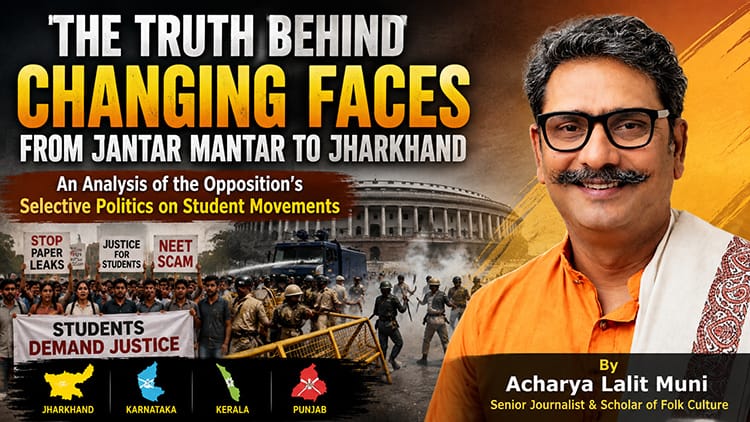
The march from Jantar Mantar to Parliament began on July 20. The protest, launched under the banner of the Cockroach Janata Party (CJP), was against paper leaks in NEET and other competitive examinations. However, when the crowd moved towards Parliament, the situation deteriorated. Some protesters allegedly threw stones at the police, attempted to break through barricades, and tried to enter the Parliament complex, an attempt that was foiled by security forces using force. In response, the police resorted to a lathi charge and fired tear-gas shells. The matter became serious enough for a petition seeking an NIA investigation into the violence to be filed in the Delhi High Court.
Soon after the incident, almost the entire Opposition, including the Congress, Aam Aadmi Party, Samajwadi Party and Left parties, descended on Jantar Mantar. Arvind Kejriwal openly supported the CJP movement and demanded that the central government stop calling young protesters anti-national. Congress president Mallikarjun Kharge demanded that Prime Minister Narendra Modi remove Education Minister Dharmendra Pradhan and apologise to the students. Rahul Gandhi sought a direct response from the government in Parliament. As a result, the Monsoon Session of Parliament was repeatedly disrupted over the issue, with proceedings being adjourned again and again.
This activism might have appeared natural if the same intensity had been visible in other parts of the country as well, where students have been protesting for months over similar issues. In Ranchi, the capital of Jharkhand, students have been protesting for more than two weeks against alleged irregularities in JPSC and JSSC examinations. On August 10, when students attempted to gherao the state Assembly, the police repeatedly used water cannons, lathi charges and tear gas. Several students were injured and dozens were detained.
Jharkhand is governed by Hemant Soren, whose government includes the Congress as an alliance partner. This is why the use of force there raises questions directly for both the Congress and the Jharkhand Mukti Morcha. Rahul Gandhi did post a brief message on social media calling the use of force wrong and advising the government to resolve the matter through dialogue. The Communist Party of India also demanded a judicial inquiry into the lathi charge. But the response was nowhere near the intensity witnessed at Jantar Mantar: there was no continuous protest in Delhi, no large gathering of MPs, no insistence on paralysing Parliament, and no sustained demand for the Education Minister’s resignation. Rahul Gandhi did not travel to Ranchi, Arvind Kejriwal did not board a flight, there was no concrete public statement from Mamata Banerjee or Akhilesh Yadav, and CJP leader Abhay Deepke was not seen among the protesting students.
BJP national spokesperson Pradeep Bhandari raised the same question publicly when he asked when Rahul Gandhi and Arvind Kejriwal would go to Jharkhand and when they would demand the resignation of the state’s Education Minister and Chief Minister. The question may have come from a political rival, but the fact remains that the anxiety and activism displayed at Jantar Mantar were not visible with the same intensity among the Opposition’s prominent faces on the streets of Ranchi.
Karnataka tells a similar story. Anger among students over the eligibility conditions for the recruitment examination for agricultural officers became so intense that the examination scheduled for August 8 and 9 had to be postponed. Students remained at Bengaluru’s Freedom Park. In the Congress-ruled state, Home Minister Priyank Kharge also courted controversy with his response to demands for his resignation. He reportedly said that protesters should first undergo a long hunger strike and face a lathi charge before he would consider resigning. He later clarified that his remarks were directed at BJP politics, but the message had already gone out: the ruling party does not appear to show the same level of firmness toward protests in its own state that it displays when opposing the central government.
In Kerala and Punjab too, student organisations have been continuously protesting over examination reforms and recruitment procedures. Kerala is governed by the Left, while Punjab has an Aam Aadmi Party government. Yet the protests in these states have never received the same national platform, media coverage or parliamentary outrage that the Jantar Mantar incident received.
This difference does not appear to be merely coincidental. When a protest is directed against the central government, the same protest becomes a political weapon for the Opposition. It becomes a reason to disrupt Parliament, demand resignations and take to the streets. But when a similar protest takes place in a state governed by one of its own allies or parties, its seriousness seems to diminish, statements become brief, and leaders do not feel the need to leave Delhi. The pain of the students remains the same; only the political calculus changes.
There is an old saying: “Sweet things are swallowed eagerly, while bitter things are spat out.” Attacking the central government over its mistakes is entirely legitimate. In a democracy, it is both the Opposition’s right and its responsibility. The question is not why voices were raised at Jantar Mantar. The question is why those same voices become so muted on the streets of Ranchi, Bengaluru, Kochi and Chandigarh. The day Opposition parties are seen standing with students in the states they govern with the same intensity and determination, genuine political integrity will become visible, and their claim of being champions of student interests will become more credible. Until then, the journey from Jantar Mantar to Jharkhand will remain merely a story of changing faces.
Acharya Lalit Muni
Senior journalist and scholar of folk culture