

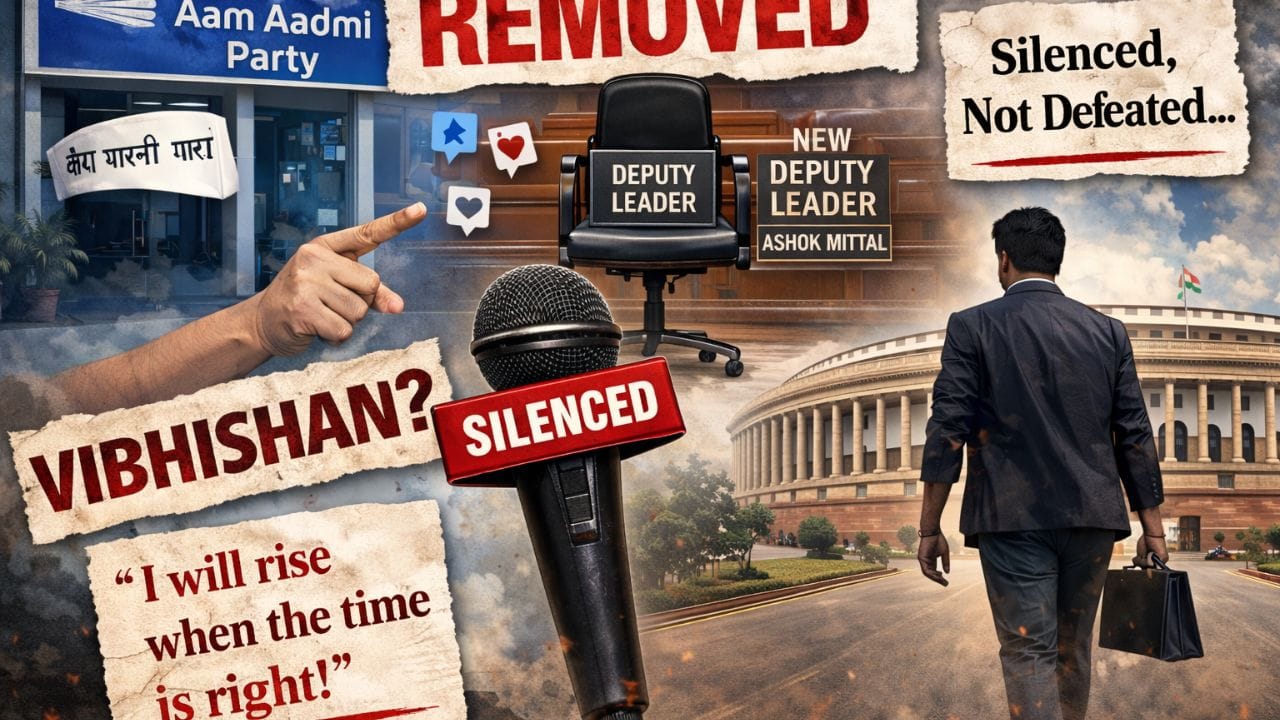
Political circles in Delhi are once again witnessing intense activity after the Aam Aadmi Party removed its prominent leader and Rajya Sabha Member of Parliament, Raghav Chadha, from the position of Deputy Leader in the Upper House. Punjab MP Ashok Mittal has been appointed in his place. In addition, the party formally informed the Rajya Sabha Secretariat that Raghav Chadha should no longer be allotted speaking time on behalf of the party. A leader once considered a close associate of Arvind Kejriwal has now been sidelined, triggering widespread discussion in political circles.
Observers believe the groundwork for this development had been laid months ago. The move appears to be more than a routine organizational adjustment and is being interpreted as the visible outcome of an ongoing internal power struggle. Social media quickly began referencing the term “Vibhishan,” raising questions about whether Raghav Chadha could emerge as a dissenting voice within the party or whether the party leadership has chosen to silence him completely.
Political analysts suggest that in any political party, tensions often arise when an individual leader begins building a distinct public identity. The Aam Aadmi Party has long been perceived as a leadership-centric organization, and leaders developing independent political profiles can sometimes create discomfort within the party structure. Chadha’s absence from recent star campaigner lists in certain elections has also been viewed by analysts as a possible signal of changing internal dynamics.
Raghav Chadha’s political journey within the Aam Aadmi Party has been notable. A chartered accountant by profession, he became part of Arvind Kejriwal’s team during the party’s early years and played a significant role in shaping its public outreach. In Parliament, he raised issues concerning mobile recharge pricing practices, high costs of basic services at airports, rights of gig workers, paternity leave, and the right to recall elected representatives. His speeches frequently went viral on social media, earning him recognition among young and middle-class audiences as a confident and articulate political figure.
However, developments over the past few months suggest a shift in circumstances. Party insiders indicate that Chadha appeared less visible at major party events involving Arvind Kejriwal and other senior leaders. During the period when Arvind Kejriwal and Manish Sisodia were facing legal challenges, Chadha’s public engagement was perceived as relatively limited. Following medical treatment in London, his political activity also appeared comparatively restrained. Some reports have mentioned concerns regarding deviation from party discipline and working outside the established party line, which may have contributed to the decision taken by the leadership.
Chadha’s response after the decision also attracted attention. He shared a video highlighting the issues he had raised in Parliament, without adding any written caption, using only emojis. Subsequently, he posted a message stating that he had been silenced but not defeated, describing himself metaphorically as a river that could turn into a flood when the time comes. The statement was interpreted as an indication of underlying tensions within the party.
Analysts are now debating whether this situation marks the beginning of a larger political shift. Such developments often indicate attempts by a political party to maintain organizational discipline and leadership authority. The Aam Aadmi Party has largely remained centered around Arvind Kejriwal’s leadership, and the growing popularity and parliamentary visibility of Raghav Chadha may have created new internal political equations.
At the same time, some observers believe that Chadha may be positioning himself as an independent voice representing the concerns of ordinary citizens. He has been associated with the India Against Corruption movement since the early phase of the party and has previously praised Arvind Kejriwal as an honest leader. If in the future he distances himself further from the party or comments on past allegations related to policy decisions and governance controversies, it could have implications for the party’s public image.
The Aam Aadmi Party has described the decision as a routine organizational matter. By appointing Ashok Mittal, the party appears to be attempting a balance between regional representation and leadership structure. However, political observers interpret the move as a possible signal of deeper internal adjustments. Other leaders, including Swati Maliwal, have also been perceived as maintaining a degree of distance from the party’s core leadership, adding to the speculation about internal differences.
Political alignments are rarely permanent, and leadership dynamics continue to evolve with time. The present development suggests that the Aam Aadmi Party may be facing a period of internal recalibration. A party that once projected itself as a symbol of clean and participatory politics now appears to be navigating the challenge of balancing internal dissent with organizational discipline.
Raghav Chadha remains a member of the Aam Aadmi Party and has not issued any formal statement regarding leaving the party. Nevertheless, his recent remarks indicate that the political situation could evolve further. The coming period will determine whether he continues to function within the party structure or chooses an independent political path. For now, his message clearly suggests that he does not consider himself politically defeated.