
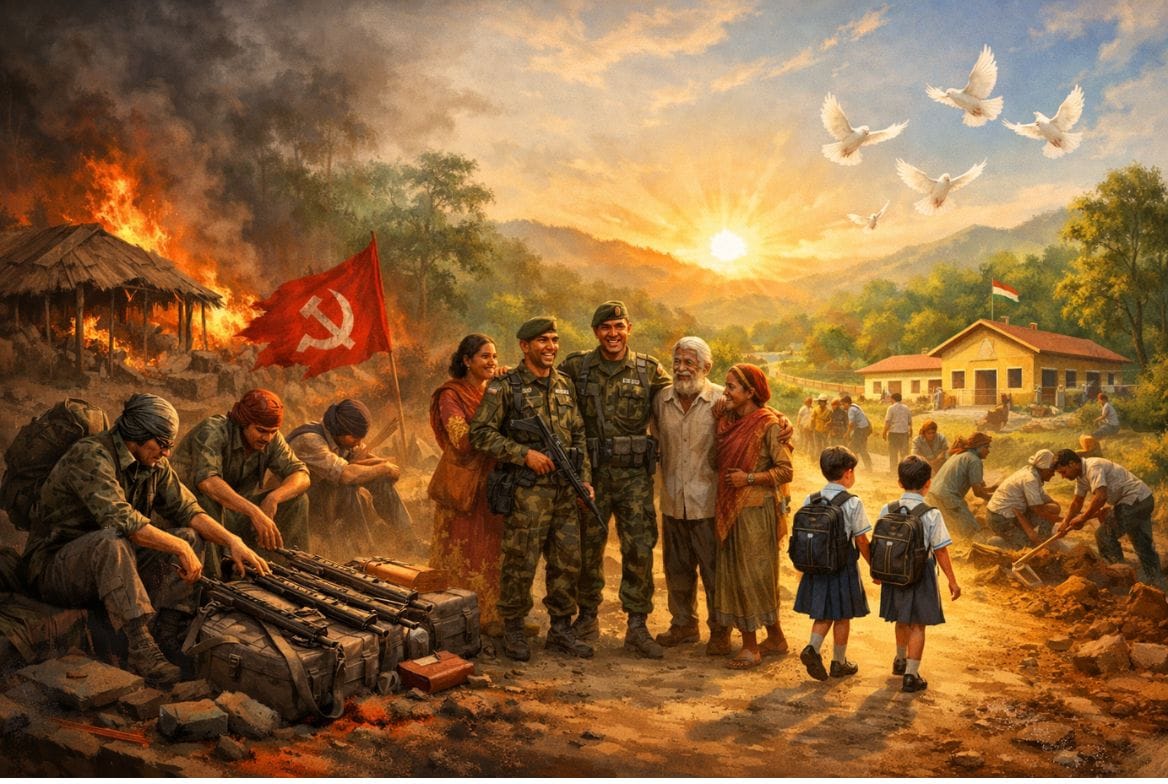

The rays of this morning have brought a new glow to the earth. The deep darkness of left wing extremist violence that had spread for nearly six decades has now formally come to an end. Most Naxalites have laid down their arms. The era of violent left wing extremism in India is now over. The doves of peace are flying freely in the open sky without fear.
The strong determination of the Modi government and the relentless efforts of the Chhattisgarh government have performed a surgical removal of this painful wound that had long troubled the nation. This is not merely a political victory, but the liberation of millions of tribal families, the result of supreme sacrifices made by thousands of soldiers, and the triumph of collective national faith. History will never forget this moment.
If we look back, the story of Naxalism began in 1967, when a small peasant uprising erupted in Naxalbari village in Darjeeling district of West Bengal. Under the leadership of communist leaders Charu Majumdar and Kanu Sanyal, poor farmers and tribal communities took up arms against landlords. The Naxalbari movement gave a violent direction to left wing ideology. Parties such as CPI ML emerged. During the 1970s, the movement spread to Bihar, Andhra Pradesh, Odisha and Madhya Pradesh. In the 1980s, organizations such as People’s War Group and Maoist Communist Centre became active. In 2004, these groups merged to form the Communist Party of India Maoist, leading to the formation of the Red Corridor. The organization established its presence in the forests of Chhattisgarh, Jharkhand, Maharashtra, Odisha and Andhra Pradesh. Using forest regions inhabited by tribal communities as hideouts, they recruited local youth in the name of protecting tribal rights, but in reality, they shed the blood of the very people they claimed to defend. They burned schools, destroyed roads, obstructed development and committed atrocities against innocent civilians. This red darkness spread like cancer in the body of the nation.
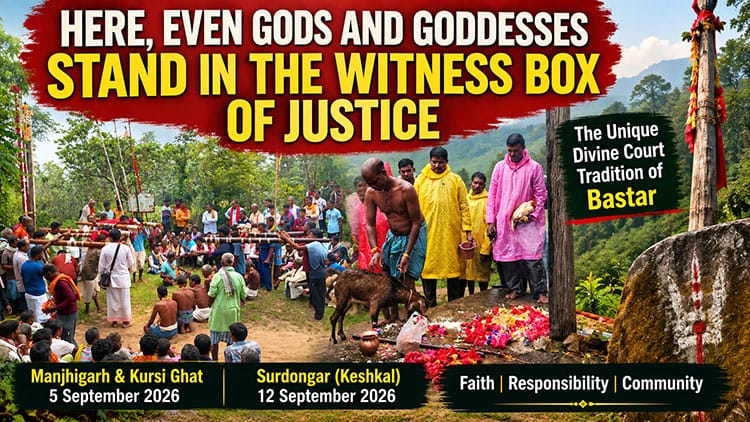
The scale of killings carried out by Naxalites is deeply disturbing. According to data from the Ministry of Home Affairs, Left Wing Extremism claimed 8,956 lives between 2004 and November 2025. Most of the victims were local residents falsely accused of being police informers. In 2010, 76 CRPF personnel were martyred in the Dantewada attack alone. Hundreds of villagers were brutally killed in Bastar. The horrific Errabore massacre remains unforgettable. Behind every such killing was a grieving family, a crying mother and a child deprived of a future. These are not just statistics but human tragedies. The forests of Chhattisgarh, once filled with tribal songs, dances and festivals, had fallen silent due to extremist violence. Many families sent their children away to cities to protect them from forced recruitment. Over time, this led to a loss of connection with traditional language, culture and ancestral beliefs.
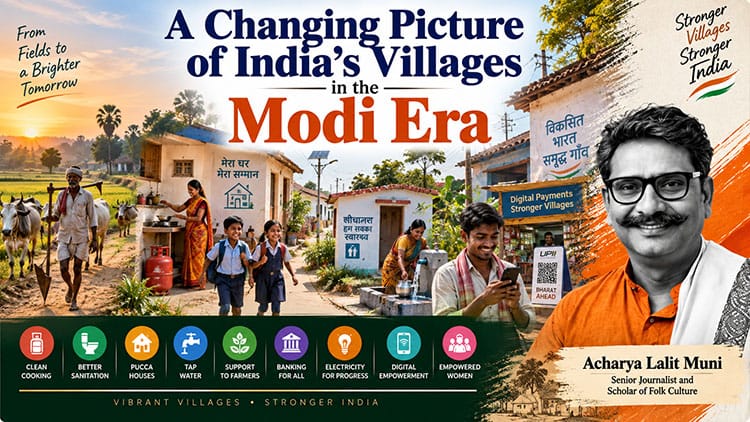
Previous governments were unable to resolve the issue effectively. Sometimes dialogue was attempted, sometimes operations were conducted, but the problem expanded to more than 100 districts. After 2014, the Modi government adopted a new approach. Prime Minister Narendra Modi and Home Minister Amit Shah implemented a three pillar strategy support, empowerment and solution. Security forces were equipped with modern resources, intelligence networks were strengthened and most importantly development was used as a strategic tool. Roads were built, electricity reached remote areas, mobile towers were installed, schools were opened and employment opportunities were created for local communities. Rehabilitation packages encouraged many Naxal cadres to surrender and return to mainstream society.
The Chhattisgarh government played a decisive role in this effort. Under the leadership of Chief Minister Vishnu Deo Sai, initiatives such as Bastar Pandum were launched. Coordination between local police and central forces increased significantly. After 2023, intensified operations led to the surrender of many cadres in Bastar region. Women also joined the mainstream. The state government emphasized that tribal communities need development, not weapons. Rehabilitation packages were expanded, skill development centres were opened and tribal youth received technical training through ITI institutions. This local effort ultimately became a national success story.
At the national level, the commitment of the Modi government has been clearly visible. In August 2024, Amit Shah declared that Naxalism would be eliminated by March 2026, and this objective now appears to be turning into reality. According to the Ministry of Home Affairs, more than 10,000 extremists have joined the mainstream since 2014. Financial networks of extremist organizations were weakened, and development initiatives gained momentum.
This is not coincidence but justice of history. Rays of peace are emerging after piercing the red darkness. The forests of Chhattisgarh are now witnessing the return of hope. School bells will ring again, roads will connect remote villages, and communication networks will bring new opportunities. People will travel without fear, and development will replace violence.
This victory belongs to the entire nation. The Modi government demonstrated determination while the Chhattisgarh government fought strongly at the local level. Together, they have removed a deep wound from the body of the nation. Those who believed that power could be achieved through violence have realized that democracy cannot be defeated by weapons. India’s civilizational values unite diversity into one thread, leaving no space for violence.
Vande Mataram.
Author
Acharya Lalit Muni