

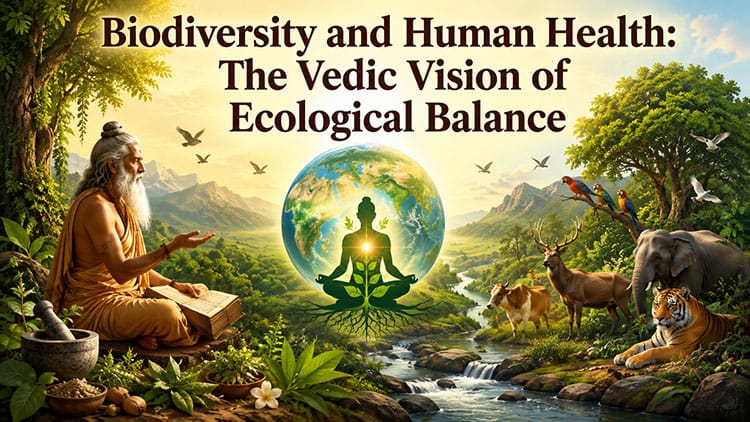

When a forest is cut down, when a river dries up, when the last creature of a species disappears from the earth, what vanishes at that moment is not merely a tree, a stream, or a living being. Along with it disappears a medicine that may have cured an incurable disease, a root that could have become a life-saving remedy, and a vital link that held together the vast web of creation. The relationship between biodiversity and human health is of this nature: deep, invisible, and inseparable.
This relationship is not new; it is ancient and eternal. Thousands of years ago, the Vedic sages recognized it and wove this understanding into their hymns, verses, and narratives so naturally that it became a part of social conduct itself. They knew that a destroyed forest would invite disease, a polluted river would invite death, and a land stripped of biodiversity would ultimately endanger human existence itself.
Meaning of Biodiversity in the Vedic Perspective
Modern science defines biodiversity as the variety of living organisms, species, and ecosystems present on Earth. Vedic philosophy, however, never confined it within rigid definitions. It accepted biodiversity as a living truth. In the Rigveda, the description of creation clearly conveys that every object, every creature, and every plant in this universe exists with a purpose.
“Yo rukmiṇīṁ vasudhānīṁ vasvīṁ sumaṅgalāṁ ca, viśvāyuṁ ca viśvakarmāṇaṁ ca tāṁ dhīmahi.”
“We meditate upon the Earth that is filled with treasures, that grants prosperity, that is auspicious, and that sustains all living beings.”
— Atharvaveda 12.1.6
The word Viśvāyu here is especially significant. It means “that in which all beings breathe and live.” This is a poetic expression of Earth’s biodiversity. The sages were declaring that the strength of the Earth lies in its diversity, in its countless forms of life.
Plants: Medicine and Life
The entire foundation of Vedic Ayurveda rests upon biodiversity. The Oshadhi Sukta of the Atharvaveda praises medicinal plants that cure diseases. In this hymn, sages pray to various herbs to restore health to the sick. This demonstrates that Vedic society considered plant diversity to be the foundation of human well-being.
“Oṣadhayaḥ saṁvadante somena saha rājñā…”
“Medicinal herbs converse with King Soma and declare: the patient for whom the learned pray shall be freed from illness.”
— Rigveda 10.97.22
The Rigveda mentions more than three hundred kinds of medicinal plants. This number itself reveals how conscious ancient society was about biodiversity. Every plant, every herb, every bark had medicinal significance. When forests are destroyed, humanity is in fact destroying a vast natural pharmacy that earlier generations carefully identified and preserved.
Modern medical science still derives many important medicines from plants. Quinine for malaria comes from tree bark, Taxol used in cancer treatment is extracted from a tree species, and several cardiac medicines are based on herbal compounds. Every extinct species may carry within it a lost opportunity for healing.
Water Purity and Biodiversity
In the Vedic tradition, rivers, lakes, and springs were regarded as living goddesses. Behind this reverence was also a profound scientific understanding. River water remains pure only when trees grow along its banks, aquatic organisms thrive within it, and surrounding ecosystems remain balanced. Biodiversity itself preserves the purity of water.
“Imaṁ me gaṅge yamune sarasvati…”
“O Ganga, Yamuna, Saraswati, Sutlej, Ravi, and other sacred rivers, accept this praise of mine.”
— Rigveda 10.75.5
The listing of rivers in this hymn is not merely an act of devotion. It acknowledges the ecological and geographical network formed around these rivers. Every river possessed its own biodiversity, its own aquatic species and vegetation that kept the waters pure. Once this biodiversity is destroyed, rivers become polluted, and polluted water becomes a grave threat to human health.
Skanda Purana and Conservation of Water Bodies
The Skanda Purana gives detailed instructions for planting trees around ponds and rivers. It states that a person who plants banyan, peepal, neem, and mango trees near water bodies earns great merit. This religious injunction was essentially an ecological policy because such trees preserve water quality, prevent soil erosion, and provide habitat to aquatic life.
Animals, Birds, and Human Health
Vedic society did not view animals and birds merely as sources of food or utility. They were considered integral parts of the cosmic order that sustains human life. Lord Shiva as Pashupati, the Lord of Animals, symbolizes the idea that all creatures are as important as human beings.
“Paśavaḥ manuṣyāṇāṁ mitram, teṣāṁ rakṣaṇaṁ dharmaḥ.”
“Animals are the friends of humankind. Protecting them is a sacred duty.”
— Vishnu Purana 3.8.15
This teaching has become even more meaningful today, when science tells us that over seventy percent of emerging infectious diseases originate in animals. By destroying forests and displacing wildlife from their natural habitats, humans force animals closer to settlements, creating pathways for new diseases to spread. In this sense, biodiversity conservation is also protection of human health.
Garuda Purana and the Animal World
The Garuda Purana describes unnecessary killing of animals and birds as a grave sin. It says that one who destroys creatures without reason suffers disease and misery for many lifetimes. This religious warning was actually a biological truth expressed in the language of dharma. A society that destroys biodiversity ultimately destroys its own health.
Soil Biodiversity and Nutrition
In Vedic agricultural traditions, the Earth was not merely a source of crops but a living mother. Soil fertility depends upon biodiversity. Millions of microorganisms, worms, fungi, and bacteria work together to maintain fertile land. Excessive chemical farming destroys this microscopic biodiversity, reducing soil strength, lowering nutritional value in food grains, and ultimately affecting human health.
“Urvārā pṛthivī mātā putro’smi pṛthivyāḥ…”
“The fertile Earth is my mother, and I am her son.”
— Atharvaveda 12.1.12
The use of the word Urvārā, meaning fertile, is intentional. The sages recognized only a living and fertile Earth as a true mother. Barren and lifeless land lacked that nurturing quality. Fertility itself emerges from biodiversity.
Agni Purana and Land Protection
The Agni Purana instructs rulers to preserve the fertility of their lands. It clearly states that when forests disappear, rivers dry up, and land becomes barren, the health and prosperity of citizens decline. This was a direct policy statement connecting biodiversity with governance and public welfare.
Epidemics, Disease, and Ecological Imbalance
The Bhagavata Purana explains that epidemics and incurable diseases emerge when humanity violates the laws of nature. This is not merely spiritual philosophy. Modern science now confirms that biodiversity loss and pandemics are closely interconnected.
“Yadā yadā hi dharmasya glānir bhavati Bhārata…”
“Whenever righteousness declines and disorder rises, I manifest myself.”
— Bhagavad Gita 4.7
The decline of dharma should not be interpreted only as moral decay. Violating nature’s balance is also a decline of dharma. When ecological harmony collapses, nature attempts to restore balance, often through calamities and epidemics. The COVID-19 pandemic reminded humanity of this truth once again.
The Atharvaveda contains prayers to forest deities for protection against fever and disease. Such verses suggest a recognition that healthy forests and biodiversity protect humanity from illness, while deforestation intensifies disease outbreaks.
“Namo astu sarpebhyo ye ke ca pṛthivī manu…”
“Salutations to all serpents dwelling on Earth, in the sky, and in the heavens.”
— Atharvaveda 11.10.1
This reverence for serpents symbolized respect for ecological balance. Snakes regulate rodent populations that destroy crops and spread disease. When snake populations decline, rodents increase, along with the diseases they carry. Ancient sages understood this ecological chain and elevated serpents to sacred status.
Herbs and Immunity
Ayurveda, regarded as the Upaveda of the Vedas, is entirely based upon biodiversity. Charaka Samhita and Sushruta Samhita describe hundreds of plants that strengthen immunity and preserve health. Ashwagandha, Tulsi, Giloy, Neem, and Turmeric are only a few examples from this vast medicinal tradition.
“Aśvattham ekaṁ pichumardam ekaṁ…”
“Every village should plant one Peepal, one Neem, one Banyan, flowering trees, pomegranate, and Jamun trees.”
— Vishnu Dharmottara Purana
This verse presents a practical environmental policy. These trees were not chosen merely for beauty but for medicinal and nutritional value. Neem acts as an antibacterial agent, Peepal enriches the air, Banyan preserves moisture, and fruit trees provide nourishment. This was a carefully planned model of biodiversity conservation.
Ecosystem Services and Human Welfare
Indian philosophy has always recognized that nature provides humanity with invaluable services: clean air, pure water, fertile soil, and regular rainfall. All these depend upon biodiversity. Modern economics calls them “ecosystem services,” whereas ancient Indian thought regarded them as divine blessings.
“Sarve bhavantu sukhinaḥ, sarve santu nirāmayāḥ…”
“May all be happy, may all be free from disease.”
— Brihadaranyaka Upanishad
The word all here does not refer only to humans. Vedic tradition wished well-being for all forms of life. Human health depends upon the health of every species and ecosystem. This idea closely resembles the modern concept of ecological health.
Markandeya Purana and Climate Disorder
The Markandeya Purana states that when injustice and ecological imbalance increase, seasons themselves become irregular. Untimely rains, droughts, excessive heat, and unpredictable cold damage human health. This description appears remarkably similar to today’s climate crisis and its health consequences.
Protecting Biodiversity: A Moral Responsibility
Vedic philosophy teaches that humanity should take from nature only what is necessary and never exploit it greedily. The famous teaching of the Isha Upanishad, “Tena tyaktena bhuñjīthāḥ” — enjoy through restraint and renunciation — is essentially a principle of biodiversity conservation.
“Īśāvāsyam idaṁ sarvaṁ yat kiñca jagatyāṁ jagat…”
“Everything in this universe belongs to the Divine. Enjoy it with restraint; do not covet greedily.”
— Isha Upanishad, Verse 1
This verse instills a moral responsibility toward biodiversity. Nature’s wealth does not belong to a single generation. It is a legacy entrusted to future generations as well. Allowing species to become extinct means endangering the health and survival of those yet to come.
Ultimately, the relationship between biodiversity and human health is not a single thread but an entire web. Just as the breaking of one strand weakens a spider’s web, the extinction of one species destabilizes the whole ecosystem. Vedic sages recognized this truth and therefore declared every tree, river, bird, animal, and even insect sacred so that society would not destroy them carelessly.
Today, when more than one-third of the world’s species stand on the brink of extinction, when forests are disappearing and rivers are becoming polluted, the teachings of the Vedas and Puranas are no longer merely spiritual lessons. They have become a matter of life and death. A society that loses its biodiversity ultimately loses its health as well.
The message of the Vedic tradition remains as relevant today as it was thousands of years ago. The Earth is our mother, every living being is our relative, and protecting them is both our greatest duty and our greatest medicine.
“Sarve Bhavantu Sukhinah, Sarve Santu Niramayah”
“May all beings be happy, may all beings be free from disease.”