

When human beings first appeared on Earth, they must have looked up at the vast luminous orb shining in the sky, rising in the east every day and setting in the west. It must have been a source of wonder for them that the same light returned to the Earth after the darkness of night. Gradually, they began to understand the importance of the Sun. The distinction between day and night, the changing seasons, the growth of vegetation and the lives of animals all appeared to be connected with the presence of the Sun. Thus, a sense of reverence developed in the human mind, and the Sun became an object of worship.
The Sun is not merely a luminous celestial body shining in the sky; it is the centre of our solar system. Its gravitational force holds the planets in their respective orbits. The Sun is also the primary source of energy essential for life on Earth. Just as the head of a family influences the functioning of the entire household, the planets of the solar system remain governed by the Sun’s gravitational force. Life on Earth would be impossible without solar energy. When human beings began observing and understanding nature, the importance of the Sun must have been among the first great discoveries.
Ancient archaeological remains, temples, sculptures and inscriptions reveal that Sun worship held an important place in many ancient civilisations across the world. From the civilisations of Egypt, Greece, Rome and Mesopotamia to the Inca and Aztec cultures, as well as the Indian subcontinent, the Sun was revered under different names and in different forms. These civilisations were separated by vast geographical distances, and their languages and religious beliefs differed considerably. Yet, reverence for the Sun was a common feature of their cultural traditions.
In ancient Egyptian civilisation, Ra was regarded as a principal solar deity. Numerous representations of the solar disc are found in Egyptian temples and hieroglyphic inscriptions. The Pharaohs associated their authority with the divine power of the Sun. During the reign of Akhenaten, the worship of Aten, represented by the solar disc, received particular importance. In ancient Greece, Helios was worshipped as the Sun god and was depicted travelling across the sky in a fiery chariot. In later Greek religious traditions, Apollo also became closely associated with the Sun.
In the Inca civilisation of South America, Inti was worshipped as the Sun god. The Inca rulers considered themselves descendants of the Sun. The Coricancha Temple in Cusco, Peru, was an important centre of Sun worship. In the Aztec civilisation of Central America, Tonatiuh was revered as the Sun god. In Japanese religious tradition, Amaterasu is worshipped as the Sun goddess. The Japanese imperial tradition regards her as the divine ancestor of the imperial dynasty. These examples demonstrate that Sun worship was never confined to a single geographical region or religious tradition.
India has an exceptionally ancient tradition of Sun worship. In Vedic literature, the Sun is described as the soul of the universe. A famous Rigvedic mantra states:
“Chitram devanamudagadaneekam chakshurmitrasya varunasyagneh।
Apra dyavaprithivi antariksham surya atma jagatastasthushashcha॥”
(Rigveda 1.115.1)
Meaning: The magnificent radiance of the gods has appeared. The Sun is the eye of Mitra, Varuna and Agni. Illuminating the heavens, the Earth and the atmosphere, the Sun is the soul of all that moves and remains stationary in the universe.
The Sun is regarded as a visible deity because every human being experiences its light and energy every day. The Vedas describe the Sun in several forms. Sometimes it is Savita, sometimes Mitra, sometimes Pushan and sometimes Vivasvan. Another name of the Sun is Bhaskara, meaning the one who generates light. In the form of Pushan, the Sun is associated with nourishment and guidance, while as Savita, it is regarded as the divine force that inspires the entire universe.
The Rigveda offers a beautiful hymn in praise of Savita:
“Aa krishnena rajasa vartamano niveshayannamritam martyam cha।
Hiranyayena savita rathena devo yati bhuvanani pashyan॥”
(Rigveda 1.35.2)
Meaning: The divine Savita travels in a golden chariot, observing all the worlds. Through its regular course, it brings the immortal and mortal worlds into their respective states of rest. This mantra beautifully describes the regular movement of the Sun and the daily rhythm of nature.
The famous Gayatri Mantra of the Rigveda is also a prayer to Savita:
“Tat savitur varenyam bhargo devasya dhimahi।
Dhiyo yo nah prachodayat॥”
(Rigveda 3.62.10)
Meaning: We meditate upon the supreme and adorable radiance of Savita, the divine source of light. May that divine brilliance inspire and guide our intellect towards the right path.
The movement of the Sun gradually became the basis for calculating days, nights, lunar fortnights, months, years and seasons. Ancient people regularly observed sunrise and sunset. They noticed that the apparent position of the Sun changed throughout the year and that these changes were accompanied by seasonal variations. The concepts of Uttarayana and Dakshinayana, referring to the apparent northward and southward movement of the Sun, are associated with these astronomical observations.
The Adityas are mentioned in Vedic literature. The number and names of the Adityas vary in the earlier Vedic texts. The concept of twelve Adityas became more clearly established in later Vedic and Puranic traditions. A well-known list includes Dhata, Mitra, Aryaman, Rudra, Varuna, Surya, Bhaga, Vivasvan, Pushan, Savita, Tvashta and Vishnu. The twelve Adityas are also associated with the twelve months of the year. Thus, Sun worship was not confined to religious rituals alone; it also occupied an important place in the understanding of time and natural cycles.
The Chandogya Upanishad discusses the Sun in connection with Pranava and meditative practices. Several Puranas, including the Brahmavaivarta Purana, describe the Sun as a manifestation of the Supreme Being. The Surya Upanishad regards the Sun as the basis of the creation, existence and sustenance of the entire universe. Vedic literature therefore presents the Sun not merely as a celestial body but also as a divine force that inspires and sustains all life.
Sun worship also has a deep connection with the development of agricultural civilisation. When human beings began practising agriculture, they understood the importance of the Sun even more clearly. Sunlight and heat were essential for everything from seed germination to the ripening of crops. Seasonal changes, the arrival of rainfall and the growth of vegetation were also connected with solar energy. Ancient agricultural communities observed the movement of the Sun to determine the appropriate times for farming activities. Traditions of expressing gratitude for food and harvest gradually developed. Since agriculture was impossible without the Sun, many ancient civilisations revered it as the giver and sustainer of life.
References to Sun worship are found not only in the Vedas and Upanishads but also in the Puranas. The Bhavishya Purana describes the significance of Sun worship and the construction of temples dedicated to the Sun. The story of Samba, the son of Lord Krishna, is also associated with Sun worship. According to a Puranic legend, Samba suffered from leprosy due to a curse attributed to Sage Durvasa. He worshipped the Sun and was subsequently cured through the grace of the Sun god. This story establishes the Sun’s position in Indian religious tradition as a deity associated with health and healing.
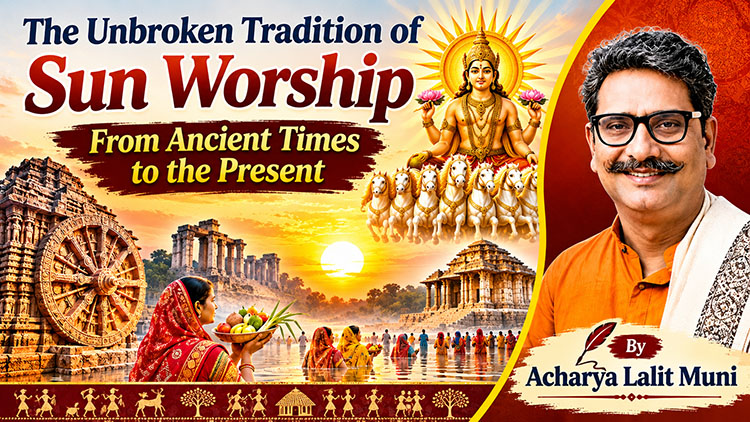
Along with the tradition of Sun worship, the art of sculpture and temple architecture also developed in India. In earlier times, the Sun was worshipped through Vedic mantras, sacrificial rituals and hymns. Later, the tradition of creating divine images and constructing temples became more widespread. In Indian sculpture, Lord Surya is generally depicted holding a lotus in each hand. He rides a chariot drawn by seven horses, with Aruna serving as his charioteer.
India has a rich tradition of temples dedicated to the Sun. The Martand Sun Temple in Kashmir, the Modhera Sun Temple in Gujarat and the Konark Sun Temple in Odisha are prominent examples. Sun sculptures and architectural remains associated with solar worship have also been found in the regions of Jhalrapatan and Osian in Rajasthan. The Konark Sun Temple is world-famous for its architectural excellence. It was conceived as an enormous celestial chariot of the Sun god. Its twelve pairs of wheels and seven horses symbolically evoke the movement of the Sun and the passage of time. The Modhera Sun Temple in Gujarat is also notable for its sculptural representations of the twelve Adityas. The Martand Temple in Kashmir holds a special place in the history of Indian architecture and Sun worship.
The tradition of Sun temples and solar symbolism also existed outside India. Egypt had temples associated with the worship of Ra and Aten. Sculptures of solar deities were created in Greece and Rome. The Inca civilisation of South America constructed temples dedicated to the Sun. The practice of associating the Sun with kingship and dynastic lineage was also prevalent in several ancient civilisations.
In India, the Sun was also revered as the divine ancestor of certain royal dynasties. According to Puranic tradition, the Ikshvaku dynasty is known as the Suryavansha or Solar Dynasty. Lord Rama is believed to have been born into this dynasty. In the Mahabharata, Karna is described as the son of the Sun god. Kings associated their lineage with the Sun to enhance the prestige and glory of their dynasties. Similar traditions existed in other civilisations, where rulers claimed descent from the Sun to establish divine legitimacy for their authority. The belief of the Inca rulers that they descended from Inti, the Sun god, is one such example.
In Indian culture, the significance of the Sun has never been restricted to religion and kingship. Ayurveda recognises the importance of sunlight and heat. In astrology, the Sun occupies a prominent position among the nine celestial bodies. The practice of Surya Namaskar in yoga is another expression of reverence for the Sun. Solar energy drives photosynthesis in plants, which form the foundation of the food chain for animals and other living organisms. The evaporation of water, the formation of clouds and the cycle of rainfall are also driven by solar energy. From this perspective, Sun worship can also be understood as a cultural expression of humanity’s dependence on nature and its gratitude towards the forces that sustain life.
The tradition of Sun worship continues to flourish in different parts of India in various forms. Makar Sankranti celebrates the Sun’s transition into Uttarayana. Rath Saptami is another important festival dedicated to the Sun, while special observances and fasts are also undertaken on Sundays. In eastern Uttar Pradesh, Bihar, Jharkhand and other parts of eastern India, Chhath is among the most prominent folk festivals dedicated to Sun worship. The festival is also celebrated with great devotion and enthusiasm in Chhattisgarh and many other parts of the country.
One of the most distinctive features of Chhath is that devotees worship not only the rising Sun but also the setting Sun. On the third day of the festival, devotees stand in rivers, ponds or other water bodies in the evening and offer Arghya to the setting Sun. The following morning, they offer Arghya to the rising Sun. Although many traditions of Sun worship exist across the world, the practice of offering prayers with equal devotion to both the setting and rising Sun makes Chhath particularly distinctive.
A natural question arises here: why is Arghya offered to the Sun even when it is setting? Perhaps this tradition reflects reverence not merely for the Sun’s radiant form but for its entire daily cycle. Even while setting, the Sun is completing its journey and preparing to rise again the following day with renewed energy. Through this ritual, human beings express their respect for this continuous natural cycle.
The offerings made during Chhath also reveal the festival’s connection with nature and agriculture. Bamboo baskets, traditional winnowing trays, coconuts, sugarcane, bananas, rice, thekua and seasonal fruits form an important part of the offerings. The presence of locally grown agricultural produce and plant materials connects the festival closely with rural life. Offering Arghya collectively on the banks of rivers and ponds also reminds people of the importance of water. Neither water nor the Sun can be separated from the existence of life.
During Chhath, devotees observe several days of rigorous discipline. Cleanliness, self-restraint, fasting and collective participation are among the defining features of the festival. People gather at riverbanks and water bodies to offer prayers to the Sun together. Traditional folk songs express devotion to the Sun and Chhathi Maiya, along with prayers for family welfare, children and prosperity. Passed down from one generation to another, this tradition continues to connect people with their cultural roots.
The tradition of Sun worship, which began with the curiosity of early human beings about nature, has continued through Vedic hymns, Upanishads, Puranas, temples and folk festivals. Times have changed, civilisations have changed and royal dynasties have disappeared, but humanity’s reverence for the Sun has endured. Modern science has made remarkable progress in understanding the Sun’s structure, energy and gravitational force. Yet, its importance in our everyday lives remains unchanged.
Chhath is a living folk tradition of this ancient heritage of Sun worship. The festival provides an opportunity to express gratitude towards the Sun, whose energy makes life on Earth possible. When thousands of people stand beside rivers and ponds to offer Arghya to the setting Sun and welcome its first rays the following morning, a cultural memory of thousands of years of solar worship comes alive in the present.
Heartfelt greetings to all devotees of the Sun on the occasion of Chhath Puja.