
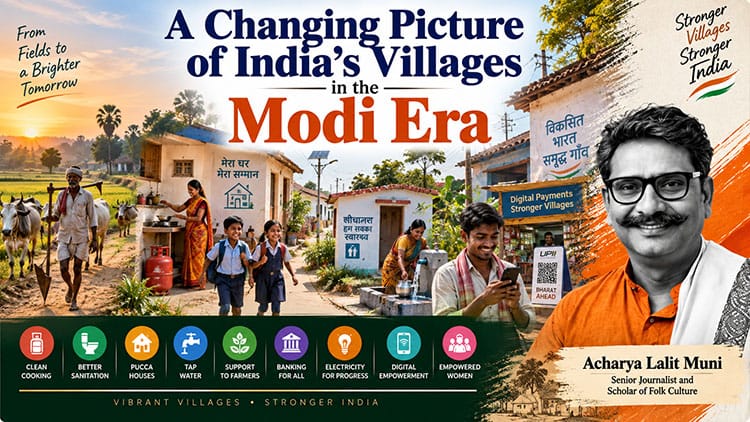
The morning in an Indian village still begins much as it did earlier, with the rising of the morning star, Sukva, the local name for Venus. The rooster crows, and as soon as the farmer spots Sukva in the sky, he leaves his cot and heads towards the fields. Women sweep their courtyards, children prepare to leave for school, and the Baradiha, the person tending to the livestock, gathers the cattle. The scene still recalls the rural India many of us knew during childhood. But if we pause and look at this picture for a while, it becomes clear that several new elements have been added to it over the past few years, revealing a changing countryside.
The kitchen where smoke from firewood and cow-dung cakes once filled the room has now become part of a pucca house, and an LPG stove can be seen there. The family for whom open defecation was once a compulsion now has a toilet in the backyard. The woman who once had to walk a long distance early in the morning to fetch water may now have a tap in her courtyard. The farmer who once had to make repeated trips to government offices to receive assistance now receives money directly into his bank account. At the village grocery shop, a young man makes a digital payment with his mobile phone, whereas during his father’s time, even visiting a bank could consume an entire day.
The village has changed, but not merely because a few new things have appeared there. The real change is that the reach of basic amenities, the state and technology into village life has expanded.
Over the past decade, the Union government under Prime Minister Narendra Modi has introduced several programmes aimed at rural India. Seen individually, these may appear to be separate government schemes. But when they are viewed together through the life of a rural family, a broader picture emerges. It is within this larger picture that the India of the Modi era can be understood.
In our time, obtaining an LPG connection often meant relying on recommendations, and even a telephone connection could require a letter of recommendation from a Member of Parliament. The Pradhan Mantri Ujjwala Yojana, launched in 2016, sought to provide LPG connections to women from poor households. According to government data, more than 10.33 crore PMUY connections had been released by July 2024. Subsequent measures have also included support and LPG subsidies for eligible beneficiaries.
For a woman who saw a gas stove enter her home for the first time, this change is more meaningful than any statistic can convey. Today, the mobile phone too has become commonplace in rural life.
For a long time, sanitation in villages was rarely discussed as one of the major development issues. The Swachh Bharat Mission, launched on October 2, 2014, brought sanitation into the centre of household and public life. The rural component, Swachh Bharat Mission-Grameen, focused on eliminating open defecation and strengthening rural sanitation. According to the government, all villages, Gram Panchayats, districts, states and Union Territories declared themselves open-defecation free by October 2, 2019, while Phase II has focused on sustaining ODF behaviour and moving towards ODF-Plus through solid and liquid waste management.
Building a toilet in a village may be a construction activity, but turning its use into a habit is a social change. That is where the deeper significance of the programme can be seen. A practice that had been accepted as normal for generations became a subject of discussion within villages. Women’s safety, children’s hygiene and health became part of household conversations. The challenge now is to ensure that sanitation infrastructure remains functional and that ODF-Plus practices are sustained.
The Pradhan Mantri Awas Yojana-Gramin has worked towards providing pucca houses to rural families. Moving from a kutcha house to a pucca house is not simply a change in construction material. It is also about reducing everyday concerns such as leaking roofs during the monsoon, the possibility of mud walls collapsing and the difficulty of keeping household belongings safe. Efforts have also been made to link these houses with other amenities such as toilets, electricity, LPG and tap water.
A house now has electricity, the kitchen has an LPG stove, there is a toilet and, in many cases, there is tap water. This is not the picture created by one scheme alone. It is the result of several policies reaching the same household and interacting with one another.
The Jal Jeevan Mission made providing tap water to rural households a national priority. When the mission was launched on August 15, 2019, about 16.72 percent of rural households had tap-water connections. According to government figures released in August 2026, the coverage had risen to 82.24 percent, with more than 15.91 crore rural households having tap-water supply at home.
This change is particularly significant in the context of women. The time spent fetching water affects both the household economy and women’s daily lives. The reduction of that burden can create more time for education, livelihoods and other activities, although the actual experience varies from household to household.
For a farmer, agriculture still means balancing between weather and the market. But the way government support enters his economic life has changed. Under the Pradhan Mantri Kisan Samman Nidhi, eligible landholding farmer families receive income support of ₹6,000 a year in three equal instalments, directly transferred to their bank accounts. Other measures include the Kisan Credit Card, crop insurance, irrigation and agricultural infrastructure programmes.
The money received by a farmer does not eliminate the risks of farming, but it can provide some financial support. Fertiliser, seeds, diesel, labour costs, market prices and weather uncertainty remain. What has changed, however, is that a more direct financial channel has developed between the government and eligible beneficiaries.
The mobile phone has become a new companion in this entire process. A farmer today does not merely look at his field. He can also check weather information on his phone, search for market prices and access information about his bank account.
The Pradhan Mantri Jan-Dhan Yojana sought to bring people outside formal banking into the banking system. The combination of bank accounts, Aadhaar and mobile connectivity has helped expand the infrastructure for Direct Benefit Transfer. Government data indicates that the number of PMJDY beneficiaries had reached 58.16 crore by May 2026.
The significance of this change becomes clearer when we consider a rural family for whom receiving even a small government payment once meant repeated visits to an office.
For rural India, Digital India does not mean merely having access to the internet. It also means a new route to banking, payments, identity verification and government services. The young man making a mobile payment at a village shop is part of an India in which the technological distance between village and city is no longer what it once was.
The journey of rural electrification is not new, but the past decade has seen continued emphasis on household electrification and expanding access to electricity. Electricity means much more than a bulb lighting up. It means a child can study at night, a mobile phone can be charged, a fan can run, a small machine can be used and household routines can change. Electricity has shortened the darkness of village nights, while solar energy is also bringing light to homes in many places.
If the changing picture of rural India were to be seen through a single face, it could well be the face of a rural woman.
The expansion of self-help groups has created opportunities for women to participate in savings, credit, small businesses and collective economic activities. Initiatives such as Lakhpati Didi have brought rural women’s incomes and entrepreneurship into public discussion. Government data released in 2026 says that more than three crore rural women had become entrepreneurs under the initiative by May 2026.
This transformation is not uniform across every village or every household. Yet the possibilities for women to move from being viewed primarily as members of the household economy to becoming economic decision-makers and entrepreneurs have expanded.
Mobile internet has challenged one of the traditional limitations of rural India. A young person in a village can now look for information about jobs, education, entertainment, news and markets on a mobile phone. Farmers can obtain information through digital platforms, while small shopkeepers can accept digital payments.
The change has become so ordinary that we may have started forgetting how remarkable it actually is.
In a village where information was once largely limited to the weekly market, newspapers or radio, the world now exists inside a mobile phone. But this also creates a new challenge. After seeing the wider world, the rural youth also wants opportunities of a similar scale for himself or herself. This is perhaps why aspiration is among the fastest-changing elements of rural India.
The defining feature of rural India in the Modi era is that government schemes have increasingly become visible inside the homes of rural families. An LPG stove, a toilet, a pucca house, a tap, a bank account, electricity, roads and a mobile phone may be the names of different schemes or infrastructure programmes, but together they create a tangible experience of change in the life of a rural household.
Yet the real test of this transformation lies in the years ahead.
Will basic amenities be followed by greater prosperity? Will financial assistance lead to greater self-reliance? Will better roads be followed by local employment?
The answers belong to the future.
But as one walks along the tarred road of a village, it is difficult to miss the fact that new colours have certainly been added to the picture of rural India. Some of these changes would have been difficult to imagine a few decades ago.
How permanent and transformative these changes will ultimately be is something only time will tell. What is certain is that the village is no longer merely the picture of the old India we heard about from our elders. It is continuously changing, asking new questions and searching for a new future of its own.