
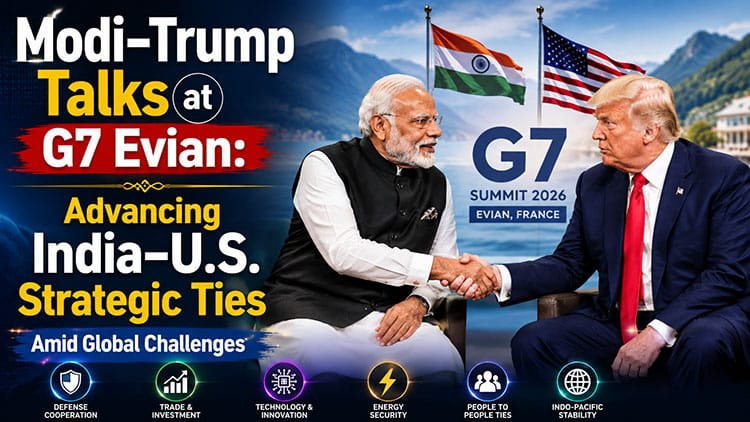

The bilateral meeting between Prime Minister Narendra Modi and U.S. President Donald Trump on the sidelines of the G7 Summit in Evian marked an important moment in the evolving India–U.S. strategic relationship. Coming amid global conflicts in West Asia, shifting power equations in the Indo-Pacific, and unresolved trade disagreements, the meeting demonstrated that New Delhi and Washington continue to view each other as indispensable strategic partners.
The two leaders reviewed progress under the India–U.S. COMPACT (Catalyzing Opportunities for Military Partnership, Accelerated Commerce and Technology) initiative and reaffirmed their commitment to advancing the broader India–U.S. Comprehensive Global Strategic Partnership encompassing defence, trade, technology, energy and people-to-people ties.
The Personal Chemistry Between Modi and Trump
The meeting once again highlighted the unusually strong personal rapport between the two leaders. Trump described PM Modi as “calm, cool, and a total killer,” highlighting his strong leadership and negotiation skills. He said Modi may appear gentle in public but is very tough in dealing and decision-making. During the interaction, Trump made headlines by saying, “If anybody attacks this man, we are going to be there to help,” a remark that reflected his personal admiration for Modi and his recognition of India’s growing strategic importance.
However, the statement was widely viewed as a personal expression rather than a formal security treaty or a legally binding defence commitment. Unlike NATO-style alliances, the India–U.S. partnership remains a strategic partnership based on converging interests, defence cooperation, and shared concerns regarding regional stability.
Defense, Security and the Indo-Pacific- Defense cooperation remained one of the central pillars of the discussion. The two countries reviewed ongoing progress in military interoperability, defence manufacturing, intelligence sharing, and cooperation in emerging domains such as artificial intelligence, cyber security and advanced technologies. The leaders reaffirmed their shared commitment to a free, open, inclusive and rules-based Indo-Pacific. Maritime security, freedom of navigation and counter-terrorism cooperation continued to be key areas of strategic convergence.
The loser defense ties with the United States provide access to advanced technologies and help diversify India’s military partnerships. For Washington, India remains a critical partner in maintaining strategic balance in the Indo-Pacific region.
West Asia Crisis and the Safety of Indian Seafarers – A major issue that was raised by Prime Minister Modi is the safety and security of civilians, particularly Indian seafarers operating in the conflict-prone waters of West Asia and the Gulf region. India, depends heavily on maritime trade routes such as the Strait of Hormuz for energy imports and commerce, emphasized the need for uninterrupted and secure shipping lanes. Modi also acknowledged President Trump’s diplomatic efforts aimed at restoring peace and stability in West Asia while underlining the importance of protecting civilian lives and ensuring maritime safety. The discussion highlighted India’s balancing approach in West Asia—maintaining strategic partnerships with the United States while continuing to emphasize regional stability and protection of its citizens abroad.
Trade Talks: Moving Towards a New Bilateral Agreement- Perhaps the most immediate area requiring diplomatic attention is trade. Off late, India and the United States have witnessed periodic disagreements over tariffs, market access, agricultural products and digital trade regulations. The Evian meeting generated optimism that both sides are close to finalizing the first phase of a broader Bilateral Trade Agreement (BTA). The planned visit of U.S. Trade Representative Jamieson Greer to New Delhi represents the next crucial stage in resolving tariff-related concerns and finalizing the framework of an interim trade arrangement. India and the U.S. already have a strong trade relationship worth over USD 190 billion a year. A new trade agreement could further increase business opportunities, attract investments, create manufacturing partnerships, and strengthen the flow of essential goods between the two countries..
Energy, Technology and the COMPACT Framework- The two leaders assessed progress under the India–U.S. COMPACT initiative, which seeks to accelerate cooperation in critical technologies, defence production, semiconductor supply chains, artificial intelligence and energy security.
India’s increasing imports of American crude oil and liquefied natural gas (LNG) have become an important dimension of economic engagement. As countries compete to lead in new technologies like AI and semiconductors, the U.S. considers India a key partner for developing secure and dependable technology networks and supply chains.
The Quad and Future Diplomatic Engagement- The leaders also discussed future cooperation through the Quad which also comprise of India, the United States, Japan and Australia. Trump announced he intends to travel to India “sometime in the future,” likely tied to a future Quad summit meeting alongside Australia and Japan. The high-level diplomatic exchanges demonstrates that the India–U.S. relationship has moved beyond transactional cooperation and now encompasses a long-term strategic vision.
India’s Strategic Gains from the Evian Meeting-The G7 bilateral meeting delivered several important gains for India:
- Reaffirmation of U.S. commitment to India’s strategic importance in the Indo-Pacific.
- Progress toward a trade agreement that could protect bilateral commerce from escalating tariff disputes.
- Deeper cooperation in defense manufacturing, advanced technologies and supply chains.
- Recognition of India’s concerns regarding the security of its citizens and seafarers in West Asia.
- Expansion of energy cooperation to support India’s long-term energy security.
- Strengthening of India’s diplomatic leverage as a key balancing power in an increasingly multipolar world.
Conclusion: A Partnership Entering a New Strategic Phase
The Modi–Trump meeting at the G7 Summit was more than a routine diplomatic engagement. It represented an effort to consolidate a rapidly expanding strategic partnership while managing areas of disagreement, especially in trade and regional security. Although President Trump’s personal assurances attracted global attention, the deeper significance of the meeting lies in the institutional strengthening of the India–U.S. relationship through the COMPACT framework, defence cooperation, technological partnerships and economic negotiations. In a world increasingly shaped by geopolitical competition, supply-chain realignments and regional conflicts, the India–U.S. partnership is emerging as one of the most consequential strategic relationships of the twenty-first century.