
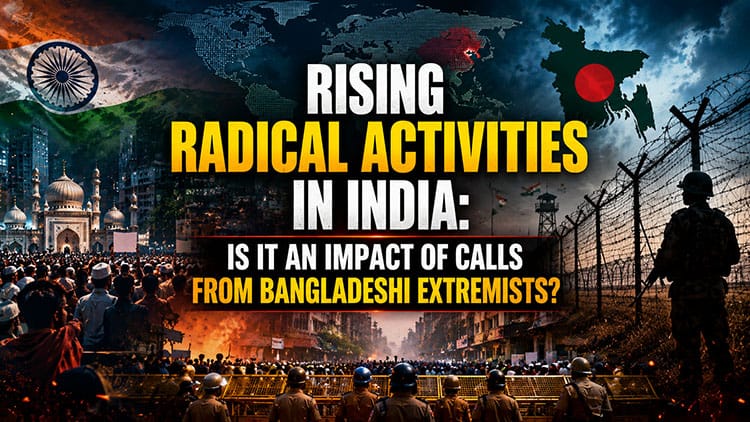

After the election results in these five states, an aggressive rise in radical activities has been witnessed across the country. The references to the Kerala Chief Minister, the decisions of the new government in Tamil Nadu, insistence on offering prayers on public roads in several cities including West Bengal, and the incidents in Sambhal and Bhopal all reflect this trend clearly. Interestingly, this increase in such incidents gained momentum after appeals by Bangladeshi extremists urging Mamata Banerjee to rebel and calling upon Muslims to support her.
The election results of these five states have conveyed several messages, indicating possible future impacts on India’s social and political landscape. One of the most surprising developments was the appeal by Bangladeshi extremist groups asking Mamata Banerjee to raise the banner of rebellion. These groups even assured support through public mobilization. Although Mamata Banerjee did not take any such step, there was a sudden rise in organized and sharp reactions among sections of Muslims in cities like Asansol, Kolkata, Bhopal, and Sambhal. Naturally, these developments raise the question: what forces are currently intensifying communal sharpness within India?
This is not the first time that governments have changed in Indian states. However, the West Bengal election results received extraordinary attention not only within India but also in media outlets in London and the United States. Pakistani and Bangladeshi media gave extensive coverage to Mamata Banerjee’s defeat and the BJP’s victory in West Bengal. The reactions suggested as though an extraordinary political shift had occurred. The strongest reactions came from Bangladesh. Perhaps no major extremist leader or organization in Bangladesh remained silent. These reactions were not ordinary political observations; they reflected visible frustration and agitation. Alongside assurances of support from Bangladesh’s eighteen crore Muslims, there were indirect attempts to provoke Muslims within India as well.
A Conspiracy to Fuel Radicalism and Instability in India
It is noteworthy that communal tensions in different Indian cities increased only after these appeals from Bangladeshi extremists. Their statements largely followed two themes. First, they spoke about protecting the interests and security of Muslims in India. Second, they openly appealed to Mamata Banerjee to declare Bengal independent.
Among those raising concerns over Muslim interests in India were leaders associated with Bangladesh’s ruling political circles as well. BNP Information Secretary Azizul Bari Helal reportedly stated that he was shocked by the crushing defeat of the TMC in West Bengal. Similarly, National Citizens Party leader Nahid Islam appealed to the international community to ensure the rights, dignity, and security of minorities and weaker sections in India.
Although these reactions were expressed within diplomatic and political language, the intention behind them appeared clear: to create fear among Muslims and maintain communal consolidation. Some extremist leaders in Bangladesh went even further by openly calling for rebellion against Delhi.
One extremist leader, Noorul Huda, congratulated Mamata Banerjee for refusing to resign despite defeat and urged her to declare Bengal an “independent nation.” He also declared that Bangladeshi Muslims would stand with her if such a step were taken. Another radical preacher, Maulana Enayetullah Abbasi, described the BJP’s victory in West Bengal as anti-Muslim and warned that if Muslims were unsafe in West Bengal, Hindus in Bangladesh would also not remain safe. He too appealed to Mamata Banerjee to raise the flag of rebellion and assured support from Bangladeshi Muslims.
Enayetullah Abbasi has earlier made inflammatory statements calling for Islamic flags to be hoisted in New Delhi and for madrassas to be turned into military bases. Known for his anti-India rhetoric, his gatherings often attract large crowds. Similar provocative remarks have also come from Jamaat-e-Islami Bangladesh chief Dr. Shafiqur Rahman. In a social media post, he claimed that Bangladesh would stand fully behind Mamata Banerjee if she declared independence. According to reports in the Dhaka Tribune, he stated that seventeen crore Bangladeshis would support and recognize such an independent state.
Although these statements were presented in the language of minority rights and Muslim protection, the deeper implication appears to be an attempt to separate Muslims from India’s national mainstream. It was precisely such separatist thinking that earlier laid the foundation for Pakistan and later Bangladesh. These extremist narratives continue to nourish that same divisive mindset.
Rising Tensions in Indian Cities
Following these statements from Bangladeshi extremists, new incidents of communal tension emerged in several Indian cities. In Asansol, Kolkata, and other areas of West Bengal, large groups insisted on permission to offer prayers on public roads, leading to administrative confrontations and social tension.
Such demands were not confined to West Bengal alone. Similar situations emerged in Uttar Pradesh, Maharashtra, Madhya Pradesh, and other states, sometimes resulting in direct confrontation. In Bhopal, following a controversial “love jihad” incident, thousands gathered in the old city areas. Although some Muslim religious leaders appealed for peace, incidents of stone-pelting and assaults on passersby heightened tensions.
Amidst these developments came the Indore High Court’s decision regarding the Bhojshala dispute in Dhar. Following the judgment, aggressive statements from leaders such as Maulana Madani and AIMIM leader Asaduddin Owaisi further increased the atmosphere of confrontation.
The Need for Greater Vigilance
Through the course of history, the themes and slogans of radical and separatist forces may change, but their underlying objectives often remain the same. Even if the statements from Bangladeshi extremists have temporarily slowed after the formation of the new government in West Bengal, it is unlikely that their activities will stop entirely.
Border infiltration from Bangladesh into adjoining Indian states has continued in a planned manner for years. According to the concerns expressed in such discussions, this infiltration is viewed not as ordinary migration but as an attempt to alter demographic balances in border regions. Therefore, there is little possibility that such conspiracies will cease altogether; rather, they may appear in new forms.
For this reason, citizens across India, and especially governments in border states, need to remain especially alert and cautious.