

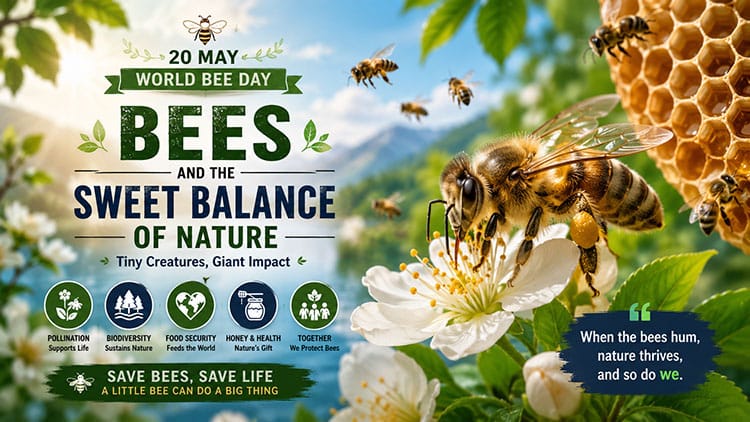

In the vast theatre of nature, the bee is a tiny yet indispensable character without whom the entire drama of life would remain incomplete. When we witness flowers blooming with the first rays of dawn, our attention is often drawn toward their colours and fragrance. Yet behind that beauty lies an invisible cycle of tireless labour and continuity of life, sustained by this small creature. Bees are not merely machines that produce honey; they are among the true foundations of the Earth’s ecological balance.
In the grand order of creation, every living being has its own place, but the role of bees is so crucial that their extinction could threaten the very existence of human civilization. Scientifically, bees are among the most active agents of pollination. A majority of the world’s food crops and fruits depend upon their movement from flower to flower. They are silent servants crafted by nature with remarkable precision. During its lifetime, a single bee visits thousands of flowers and unknowingly sows the seeds of life everywhere it goes.
From a human perspective, the life of bees is one of the finest examples of discipline and cooperation. The world inside a beehive resembles an ideal social system where every member has a defined responsibility and the collective welfare remains the ultimate goal. This family of one queen bee and thousands of worker bees teaches humanity that unity and dedication are essential for achieving great purposes. For centuries, human beings have learned valuable lessons from bees.
The architecture of a beehive itself is a marvel of geometry. The hexagonal structure of honeycombs provides maximum storage in minimum space, a design that continues to inspire engineers and architects even today. Bees may also be seen as ascetics of nature who gather little for themselves while leaving sweetness for the world. Honey is not merely a food product; it is the essence of the labour of bees, regarded as nectar both in Ayurveda and modern medicine.
From the perspective of ecological balance, the contribution of bees is immense. They are essential not only for human food production but also for the survival of wild plants and countless other living organisms. Without pollination by bees, forest regeneration would slow down, eventually affecting rainfall cycles and biodiversity. Their role in maintaining ecological diversity is invaluable. Even in today’s global economy, bees contribute indirectly trillions of dollars because agricultural productivity is deeply dependent on pollination.
A closer observation of bees reveals the extraordinary intelligence of nature. Bees are not only hardworking but also possess a highly sophisticated communication system. Through the famous “waggle dance,” they convey precise information to fellow bees regarding the distance and direction of flowers. This remarkable method of communication has functioned successfully for thousands of years without any artificial technology. In human society, where lack of communication often creates conflict, the harmony among bees offers a profound lesson.
Bees also teach humanity the virtue of patience. To produce a single spoonful of honey, they must visit millions of flowers. Their dedication reminds us that great achievements are built through the accumulation of countless small efforts. Bees never damage the flowers they visit; instead, they help them bear fruit before departing. This is the true lesson of coexistence with nature, a lesson modern humanity desperately needs to relearn.
Historically and culturally, bees have always enjoyed a place of reverence. Ancient civilizations considered them symbols of purity, fertility, and industriousness. In the Rig Veda, honey is described as the food of the gods, and prayers are offered for the well-being of bees. In folklore and poetry across cultures, bees have symbolized tireless action and sweetness in speech.
However, the challenges of the present age are alarming. If bee populations continue to decline, the first consequence will be the disappearance of diversity from our food systems. Gradually, forests will lose their richness, and eventually the entire ecological system may collapse. This is not merely the disappearance of a species; it is the breaking of the delicate thread that binds all life together.
Bees teach us how to enrich life without exploiting nature. A bee takes nectar from a flower yet does not leave even a scratch upon its petals. In contrast, humanity’s model of development has often wounded nature deeply. We must transform our agricultural practices and promote organic farming so that these tiny pollinators may survive safely.
The humming sound of bees is, in truth, the heartbeat of nature itself. If this hum falls silent, an emptiness will spread across the world that may never again be filled. The Rig Veda beautifully declares:
“Madhu vāta ṛtāyate madhu kṣaranti sindhavaḥ।
Mādhvīrnaḥ santvoṣadhīḥ॥”
Meaning: “May the winds blow sweetly and beneficially for us; may the rivers flow with sweetness; and may the herbs and medicines bring welfare to us.”
Acharya Lalit Muni
Senior journalist and scholar of folk culture.