

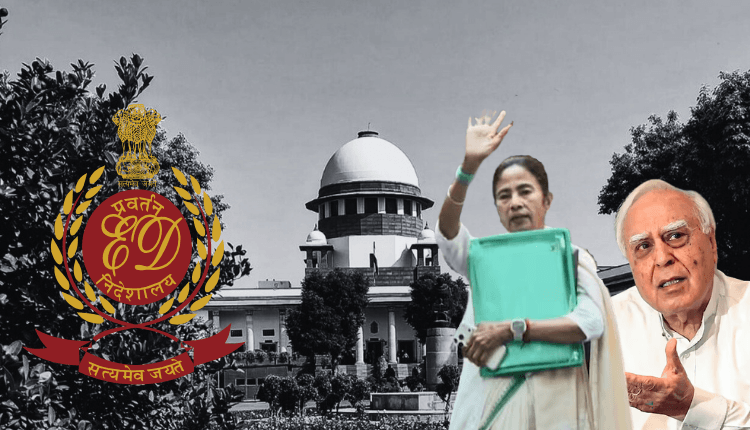
The Supreme Court on Thursday heard intense arguments between the Enforcement Directorate (ED) and West Bengal Chief Minister Mamata Banerjee over allegations that she and senior state officials interfered with a central agency’s investigation linked to a money laundering case.
The case relates to ED search operations at the Kolkata offices of political consultancy firm I-PAC and the residence of its co-founder, Pratik Jain. The court termed the matter “very serious” and said it would examine the allegations closely.
ED Alleges Obstruction by Chief Minister
Appearing for the ED, Solicitor General Tushar Mehta told a bench comprising Justices Prashant Kumar Mishra and Vipul Pancholi that the agency had uncovered what he called a “shocking pattern” of obstruction.
According to Mehta, whenever statutory authorities attempted to carry out their duties, the chief minister allegedly intervened. He claimed that during the raid, Mamata Banerjee arrived at the premises along with the Kolkata Police Commissioner and staged a sit-in protest.
Mehta argued that such actions could demoralise central agencies and set a dangerous precedent. He urged the court to take strict action against officials who were allegedly present during the incident.
ED Seeks FIR, Suspensions, and CBI Probe
The ED has sought the suspension of senior West Bengal Police officials, including Director General of Police Rajiv Kumar. It also requested directions to the Union Home Ministry and the Department of Personnel and Training to initiate action.
Additional Solicitor General SV Raju argued that the facts disclosed cognisable offences such as theft and obstruction. Citing the Lalita Kumari judgment, he said registration of an FIR was mandatory in such cases.
Raju further claimed that since Mamata Banerjee also holds the Home Ministry portfolio in the state, a probe by the state police would not be impartial, making a CBI investigation necessary.
Kapil Sibal Questions Timing of ED Action
Senior advocate Kapil Sibal, representing Mamata Banerjee and the Trinamool Congress (TMC), strongly challenged the ED’s case, particularly the timing of the raid.
“Why was there a need to initiate this just before elections?” Sibal asked, pointing out that the ED’s own petition stated that the last statement in the case was recorded in February 2024.
He argued that the search was conducted at premises linked to election strategy work. “Everyone knows I-PAC handles election campaigns in West Bengal. The formal contract with TMC dates back to 2021,” Sibal said, suggesting the raid risked exposing confidential electoral data.
Dispute Over Seizure of Devices
Sibal also rejected the ED’s claims that multiple digital devices were seized. He referred to video recordings and the panchnama to argue that only Pratik Jain’s phone and laptop were taken.
“It is a blatant misrepresentation to say that all devices were seized,” he said, adding that the search was carried out peacefully.
Heated Exchanges in Court
The hearing saw sharp exchanges between the lawyers, prompting the bench to step in several times. Justice Mishra questioned thes the maintainability of the ED’s plea and warned counsel against turning the proceedings into a spectacle.
When Mehta alleged that the Calcutta High Court had been turned into a protest site, the bench cautioned him, saying, “Don’t create ruckus here.”
At one stage, the court said it would issue notice in the matter, stressing the seriousness of the allegations.
Background: I-PAC Raid and Coal Scam Case
The ED informed the court that it was conducting searches under the Prevention of Money Laundering Act (PMLA) at 10 locations linked to I-PAC as part of a probe into an alleged ₹2,742-crore illegal coal mining and sale racket.
Mehta claimed that during the raid, the chief minister took possession of digital devices and documents, describing the incident as “pure theft.” This claim was firmly denied by the defence.
The Supreme Court is expected to examine the allegations in detail in the coming hearings.