

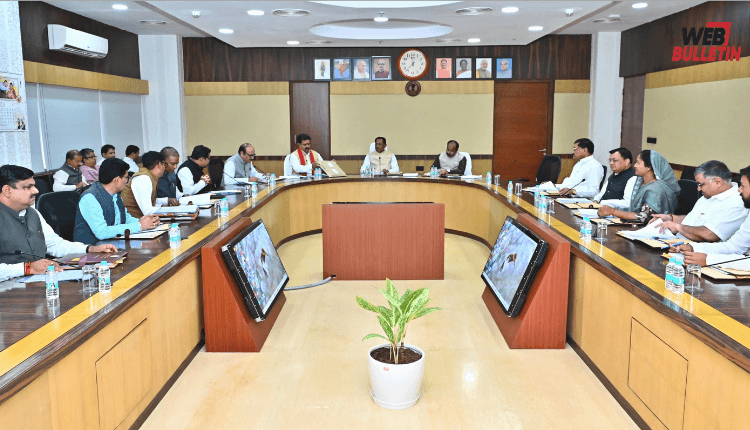
The Chhattisgarh Cabinet, chaired by Chief Minister Vishnu Deo Sai, on Wednesday approved a series of major policy and administrative decisions aimed at strengthening law enforcement, boosting employment, improving urban services and accelerating digital transformation in the state. The decisions were taken during a cabinet meeting held at Mantralaya Mahanadi Bhavan.
Anti-Narcotics Push Across 10 Districts
In a significant move to curb drug trafficking, the Cabinet approved the creation of District-Level Anti-Narcotics Task Forces in 10 districts. A total of 100 new posts sanctioned in the 2025–26 budget will be deployed across Raipur, Mahasamund, Bilaspur, Durg, Bastar, Surguja, Kabirdham, Jashpur, Rajnandgaon and Korba.
Special Operations Group Gets Approval
The Cabinet also cleared 44 new posts for the formation of a Special Operations Group (SOG) under the Police Headquarters’ Special Branch. The SOG will be a highly trained rapid-response unit designed to handle sudden emergencies, major security threats and potential terror-related incidents.
Flight Training Organisations to Come Up in the State
To tap the growing demand in the aviation sector and create employment opportunities for youth, the Cabinet approved the establishment of Flight Training Organisations (FTOs) at various airports and airstrips in Chhattisgarh. The initiative will be implemented through private sector participation and is expected to support allied activities such as aircraft recycling, helicopter bunkering and aero sports.
New Startup Policy Approved
The Cabinet approved the Chhattisgarh Innovation and Startup Promotion Policy 2025–26, aimed at strengthening the startup ecosystem by supporting incubators and stakeholders. The policy seeks to position Chhattisgarh as a leading innovation hub and improve its ranking in the State Startup Rankings issued by the Government of India, thereby enhancing investor confidence.
35 Residential Colonies to Be Handed Over to Urban Bodies
In a major relief to residents, the Cabinet decided to transfer 35 completed residential colonies developed by the Chhattisgarh Housing Board and Raipur Development Authority to municipal corporations and municipalities. This move will enable civic bodies to provide essential services such as water supply, roads, electricity, sanitation and maintenance, and will eliminate the burden of dual charges currently faced by residents.
Multi-Storey Office Complex Planned in Nava Raipur
To ensure optimal land utilisation, the Cabinet approved the construction of a large multi-storey office complex in Nava Raipur Atal Nagar for government departments and public sector bodies. Office spaces will be allocated within the building to centralise administrative operations.
Land Allocation Powers Delegated for Sirpur and Arpa Regions
To accelerate planned development in the Sirpur and Arpa river regions, the Cabinet authorised district collectors to allocate government land in these areas. Considering the financial position of the Special Area Development Authorities, land will be allotted at a nominal premium of Re 1 along with standard lease charges.
‘Cloud First Policy’ Gets Cabinet Nod
The Cabinet approved the implementation of the Chhattisgarh Cloud First Policy, proposed by the Department of Electronics and Information Technology. Under the policy, all government departments and institutions will use cloud services only from MeitY-approved providers or secure data centres located within India.
Low-priority applications will migrate to the cloud by 2027–28, while high-priority services will transition by 2029–30. All new applications will be developed using cloud-native technologies. The policy is expected to reduce IT costs, enhance cybersecurity, ensure service continuity during disasters and improve 24×7 citizen services.
Mobile Tower Scheme to Expand Digital Connectivity
To bridge connectivity gaps in remote and Left-Wing Extremism-affected areas, the Cabinet approved a Mobile Tower Scheme aimed at expanding digital infrastructure. The scheme will simplify and fast-track permissions for service providers to install towers in uncovered habitations.
The initiative is expected to strengthen governance delivery, boost rural economic activity, enhance security operations and expand access to essential services such as public distribution systems, direct benefit transfers, healthcare, education and emergency services like Dial 112.