


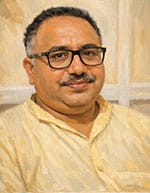
A picture and several claims associated with it have been circulating on social media. The claim is that several members of the family of Chief Election Commissioner Gyanesh Kumar entered the civil services after 2014, and that this is being linked to political patronage or an established system of favour.
Such claims should not be examined through political preferences or emotional reactions. They should be examined through facts, examination years, ranks, batches, selection procedures and the sequence of events.
Start with the facts
Gyanesh Kumar is a 1988-batch IAS officer. He became an Election Commissioner in March 2024 and assumed office as Chief Election Commissioner in February 2025.
His elder daughter, Medha Roopam, is a 2014-batch IAS officer of the Uttar Pradesh cadre. She secured approximately 10th rank in the UPSC Civil Services Examination 2013. The result was declared in 2014.
Manish Bansal, who later became her husband, is also a 2014-batch IAS officer and is reported to have secured approximately 53rd rank in the same examination. The two reportedly met during training at the Lal Bahadur Shastri National Academy of Administration (LBSNAA) and married subsequently.
The relevant sequence is therefore: Examination → Result and Rank → Selection → Training → Marriage
That sequence matters because it shows that the examination and selection had already taken place before their marriage.
The younger daughter, Abhishri, entered the IRS through UPSC CSE 2017 and is reported to have secured approximately AIR 297. Her husband, Akshay Labroo/Labroo, is reported to have secured approximately AIR 104 in the same examination and subsequently entered the IAS.
Some reports differ on certain details concerning Akshay Labroo’s batch/year, so those details should be stated cautiously.
The wider family is also reported to include other members associated with the civil services, including relatives connected with the IRS and IPS.
The central question: how does UPSC selection work?
This is the point that often gets lost in social-media narratives.
Entry into services such as the IAS and IRS takes place through the prescribed UPSC examination process, involving written examinations and an interview/personality test.
A candidate’s relationship with a senior government officer does not, by itself, establish that the candidate was selected because of that relationship.
Similarly, being selected in or after 2014 does not, by itself, establish that the selection was a political favour.
The reported ranks are also relevant. A candidate securing approximately AIR 10 or AIR 53 cannot simply be explained away by pointing to a family relationship. If someone alleges manipulation or preferential treatment, the allegation requires evidence of manipulation or an irregularity in the selection process.
Family connections are not automatically evidence of wrongdoing
A family may have several civil servants for many reasons: educational environment, familiarity with competitive examinations, professional exposure, guidance and shared aspirations.
Civil servants also meet one another during training and service. Marriage between officers is therefore not, by itself, evidence of an improper selection.
The appropriate distinction is simple:
Family connection is a fact.
Preferential selection is an allegation.
Evidence is required to establish the allegation.
If there is documentary evidence of unlawful intervention, examination manipulation or an improper advantage in any particular selection, that evidence should be examined independently.
But a family tree alone cannot establish such a conclusion.
Where does the misleading narrative come from?
A complex story can easily be reduced to a single emotionally attractive sentence:
“They all got government jobs after 2014.”
But that formulation leaves out the most important information—the examination, the rank and the selection process.
The more useful questions are:
* When was the examination held?
* What was the candidate’s rank?
* When was the result declared?
* When was the selection made?
* When did the relevant relationship arise?
* When did Gyanesh Kumar become Election Commissioner and later CEC?
These questions help separate chronological facts from political interpretation.
The crucial point is that the civil-service selections being discussed took place years before Gyanesh Kumar became Chief Election Commissioner. His appointment to the Election Commission came in 2024 and his appointment as CEC in 2025.
Therefore, connecting those earlier selections to his later constitutional position requires additional evidence, not merely an inference from the family relationship.
Narrative versus evidence
This is a broader lesson in the age of social media.
A narrative may begin with a genuine fact—there are several civil servants in a family.
The next step may add another fact—their selections happened in different years.
The final step may introduce an interpretation—that these selections were therefore politically arranged.
But these are three different things: Fact → Connection → Conclusion
The first may be documented. The second needs examination. The third requires evidence.
Confusing the three is how misinformation, half-truths and politically charged narratives can acquire the appearance of established fact.
Conclusion
A person’s merit should be assessed through examination performance, rank, selection process, service record and public record—not simply through family connections.
Likewise, having several civil servants in one family is not, by itself, evidence of corruption or political patronage.
If there is a specific allegation of manipulation, the proper response is not another counter-narrative. It is evidence, documents and an examination of the relevant selection process.
And one important caution remains: claiming that a particular political or ideological group is deliberately spreading misinformation is itself a political claim. Unless supported by evidence, it should not be presented as an established fact.
The principle is simple:- Check the facts. Check the process. Check the chronology. Then examine the claim.
Facts are facts. Opinions are opinions.
And a family tree is not, by itself, proof of a conspiracy.