
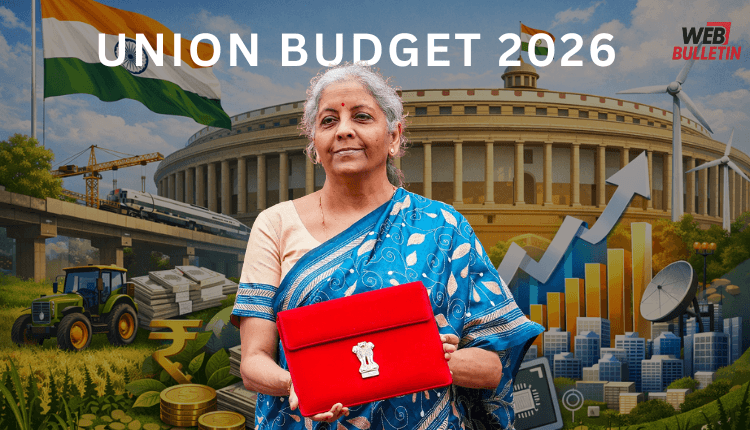
New Delhi: Union Finance Minister Nirmala Sitharaman on Saturday presented her ninth consecutive Union Budget, creating a record for any Finance Minister in India’s history. In her 83-minute Budget 2026 speech, Sitharaman underlined the government’s commitment to reforms over rhetoric, fiscal discipline and long-term economic stability amid a challenging global environment.
The Finance Minister said India’s economic journey over the past 12 years has been marked by stability, sustained growth and moderate inflation, achieved through “conscious policy choices even during periods of global uncertainty and disruption.” She emphasised that trade and multilateralism remain imperative in the current external environment.
Three ‘Kartavyas’ Guiding Budget 2026
Sitharaman said the Budget was framed around three key ‘kartavyas’ or duties. The first is to accelerate and sustain economic growth by enhancing competitiveness and resilience to volatile global dynamics. The second focuses on fulfilling the aspirations of people by building their capabilities and making them partners in India’s growth story. The third aims to ensure “sab ka saath, sab ka vikas,” ensuring that every family, community and region has access to opportunities and resources.
Manufacturing, Infrastructure and Strategic Sectors
To accelerate growth, the Finance Minister proposed interventions across six broad areas, including scaling up manufacturing in seven strategic sectors, rejuvenating legacy industries, creating champion MSMEs, pushing infrastructure development, ensuring long-term economic stability and developing city economic regions.
A major announcement was the launch of BioPharma SHAKTI, with an outlay of Rs 10,000 crore over the next five years, to position India as a global hub for bio-pharma manufacturing, particularly biologics and biosimilars. The semiconductor push will continue with ISM 2.0, expanding beyond fabrication to include equipment, materials and design, while the Electronics Components Manufacturing Scheme outlay has been increased to Rs 40,000 crore.
Public capital expenditure is projected to rise to Rs 12.2 lakh crore in FY27. Infrastructure development will continue in Tier-II and Tier-III cities, identified as emerging growth engines. A new “City Economic Regions” initiative will support structured economic planning in these urban centres.
Rail, Connectivity and Industrial Corridors
Sitharaman announced seven high-speed railway corridors to act as “growth connectors,” linking Mumbai-Pune, Pune-Hyderabad, Hyderabad-Bengaluru, Hyderabad-Chennai, Chennai-Bengaluru, Delhi-Varanasi and Varanasi-Siliguri. The Budget also proposes operationalising 20 new National Waterways to reduce logistics costs.
Dedicated rare-earth mineral corridors will be established in Odisha, Kerala, Andhra Pradesh and Tamil Nadu to strengthen critical mineral supply chains.
MSMEs, Textiles and Employment
Recognising MSMEs as vital growth drivers, the government will adopt a “Champion MSME” approach, supported by a Rs 10,000 crore SME Growth Fund for equity financing. A cadre of “Corporate Mitras” will be created to help smaller enterprises comply with regulations.
In the textiles sector, the government will set up mega textile parks in challenge mode and launch the Mahatma Gandhi Gram Swaraj Yojana to strengthen khadi and handloom industries through training, skilling, production support and quality checks.
Agriculture, AI and Rural Economy
The rural economy will receive a technology boost through Bharat-VISTAAR, a multilingual AI platform integrating agri-stack portals and ICAR data to provide farmers with customised advice. The Budget also promotes diversification into high-value crops such as cashew, cocoa and walnuts, along with a coconut promotion scheme for coastal states.
Fishing by Indian vessels in the Exclusive Economic Zone and high seas will be duty-free, with landings at foreign ports treated as exports.
Education, Services and Digital Push
The Finance Minister proposed a high-powered Education to Employment and Enterprise Standing Committee to strengthen the services sector and help India achieve a 10% global share by 2047. Content creator labs will be set up in 15,000 schools and 500 colleges to boost the Animation, Visual Effects, Gaming and Comics sector.
Climate, Sports and Women Entrepreneurs
An outlay of Rs 20,000 crore over five years has been proposed for Carbon Capture, Utilisation and Storage technologies. The sports goods industry will receive support through a dedicated manufacturing and research initiative. SHE (Self-Help Entrepreneur) Marks will be established as community-owned retail outlets to support women entrepreneurs.
Northeast and Purvodaya Focus
The Budget gives a major push to eastern India and the Northeast under Mission Purvodaya, including an integrated East Coast industrial corridor, five tourism destinations, 4,000 e-buses and development of Buddhist circuits across several northeastern states.
Taxation and Fiscal Outlook
No changes were announced in income tax slabs. However, significant relief was provided through decriminalisation of minor tax offences, including non-production of books of accounts and TDS defaults where payments are made in kind. The timeline for revising income tax returns has been extended to March 31 with a nominal fee, and filing deadlines will be staggered.
The fiscal deficit is projected at 4.4% of GDP in FY27 and 4.3% in FY28, reflecting continued fiscal consolidation.
Overall, Budget 2026 signals a strong push towards manufacturing, infrastructure, technology adoption and inclusive growth, while maintaining fiscal discipline and policy continuity.