
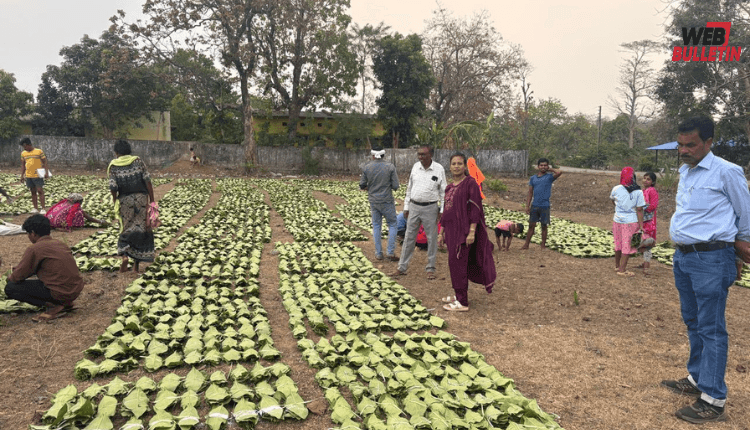
In a significant step toward strengthening rural livelihoods, the Chhattisgarh government has introduced key measures to enhance the earnings of tendu leaf collectors—often referred to as “green gold” harvesters in forest regions. These initiatives are expected to benefit over 1.3 million families dependent on this seasonal activity.
Tendu leaves, widely collected across forested belts of the state, serve as a crucial source of income for tribal and forest-dwelling communities. With revised policies and improved procurement rates, the government anticipates a total payout of nearly ₹920 crore to collectors this season.
Under the direction of Forest Minister Kedar Kashyap, the state has increased the collection rate per standard bag from ₹4,000 to ₹5,500 starting in 2024. This hike is aimed at ensuring better returns for collectors and improving their economic stability.
For 2026, tendu leaf collection will be carried out through 902 primary cooperative societies operating under 31 district forest produce unions. The state expects the collection of around 1.5 million standard bags, with each bag containing 1,000 bundles of 50 leaves each.
Expansion in Bastar and Other Regions
In the Bastar division, 216 societies under 10 district unions have been assigned a target of approximately 400,000 standard bags. Meanwhile, the remaining 21 unions across the state are projected to contribute nearly 1.1 million standard bags.
The number of families engaged in the activity has also grown. In Bastar alone, participation has increased from 390,000 families in 2025 to over 404,000 this year, with more than 14,000 new families joining the effort.
New Collection Centers and Improved Access
For the first time, 10 new collection centers have been established in the remote Abujhmad region of Narayanpur district, where over 2,100 standard bags are expected to be collected. Additional centers have also been introduced in Sukma and Keshkal to improve accessibility.
Last year, operations in several Naxal-affected areas were disrupted, leaving 351 collection points inactive. However, authorities have ensured full operational readiness this year, aiming to resume activities across all centers.
Transparent Payments and Better Infrastructure
To streamline the process, the government has arranged essential logistics including collector ID cards, bags, storage facilities, and transportation. Insurance coverage for stored tendu leaves has also been introduced.
Importantly, payments will be made through a digital system, ensuring direct benefit transfer (DBT) into collectors’ bank accounts. This move is expected to enhance transparency and eliminate delays.
Strengthening Rural Economy
With an estimated ₹920 crore set to be disbursed, the initiative is likely to inject significant liquidity into rural and tribal economies. Officials believe that these efforts will not only raise incomes but also improve overall living standards in forest-dependent communities.
The government’s renewed focus on tendu leaf collection underscores its broader commitment to empowering forest dwellers while reinforcing the rural economic framework of the state.